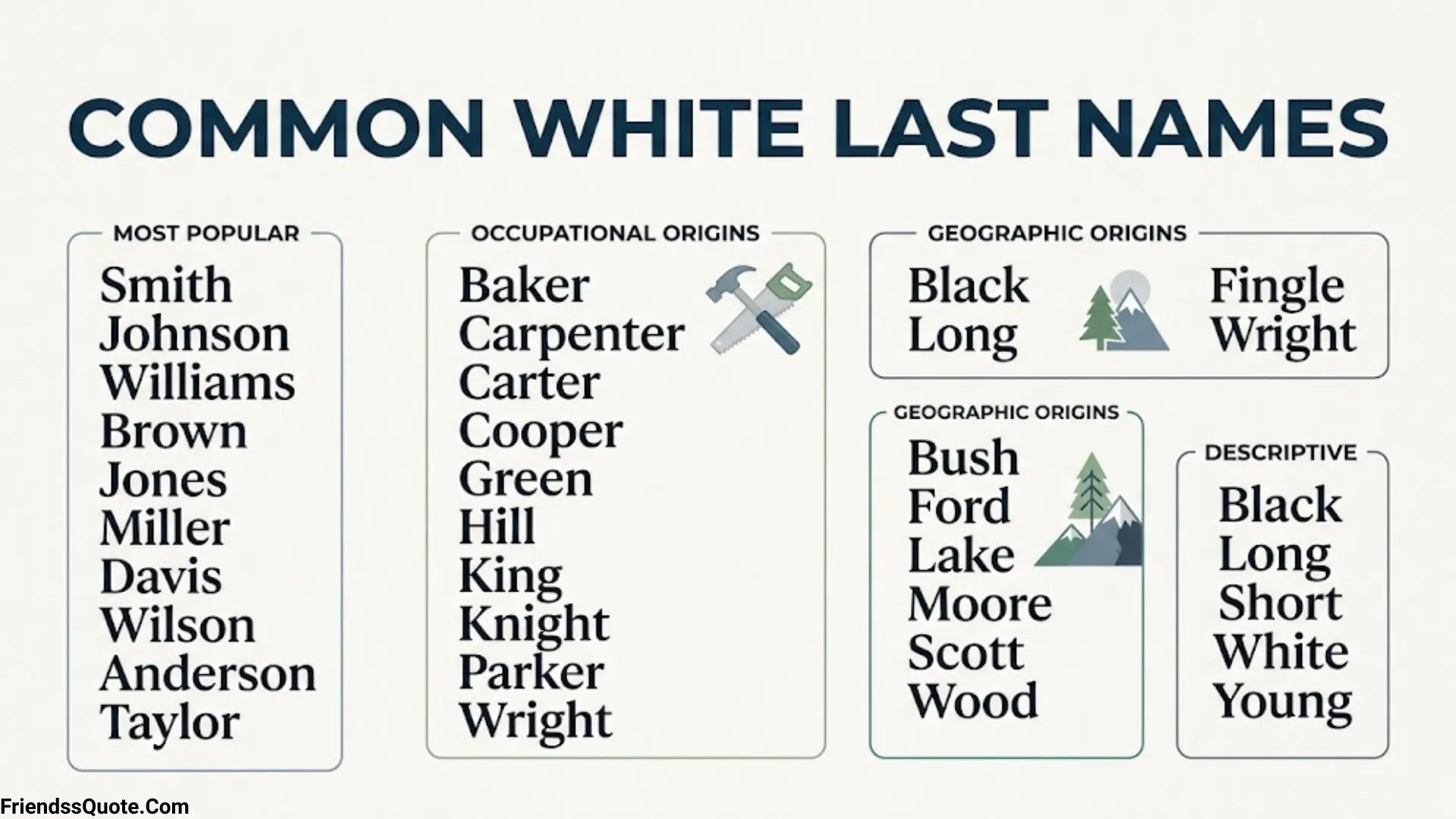
Common White last names often include surnames with English, Irish, Scottish, German, French, and other European origins. Names such as Smith, Miller, Taylor, Anderson, and Bennett are familiar in the United States. Many developed from occupations, personal names, places, or descriptions passed down through generations. Their meanings can offer interesting clues about language and history.
Some surnames are widely used across America, while others are associated with prominent historical families or appear in older census records. You may also be looking for uncommon surnames, names that sound prestigious, or last names beginning with a particular letter. Exploring these categories can help you find meaningful surname examples for genealogy, family history, or character naming.
However, no last name belongs exclusively to White people, and a surname alone cannot prove someone’s race or ancestry. Many surnames are shared by people from different backgrounds, and the same name may have several origins. In this guide, you’ll discover common last names, their possible meanings, historical examples, and practical ways to research a surname more accurately.
What Does “White Last Names” Mean?
People often use “White last names” to mean surnames associated with European ancestry or frequently found among White Americans. These surnames may have English, Irish, Scottish, German, French, Italian, Scandinavian, or other European roots.
However, surnames can cross cultural and racial boundaries. Migration, marriage, adoption, name changes, and shared linguistic traditions have all contributed to the spread of family names. Two people with the same surname may have completely different family histories.
The U.S. Census Bureau publishes surname frequency data and tables showing how surname patterns relate to respondents’ reported race and Hispanic origin. Those statistics describe population patterns, not the identity or ancestry of every person with a particular name.
For that reason, the lists below focus on European-origin surnames and names familiar in the United States rather than claiming that any name is exclusively White.
Common White Last Names With Meaning
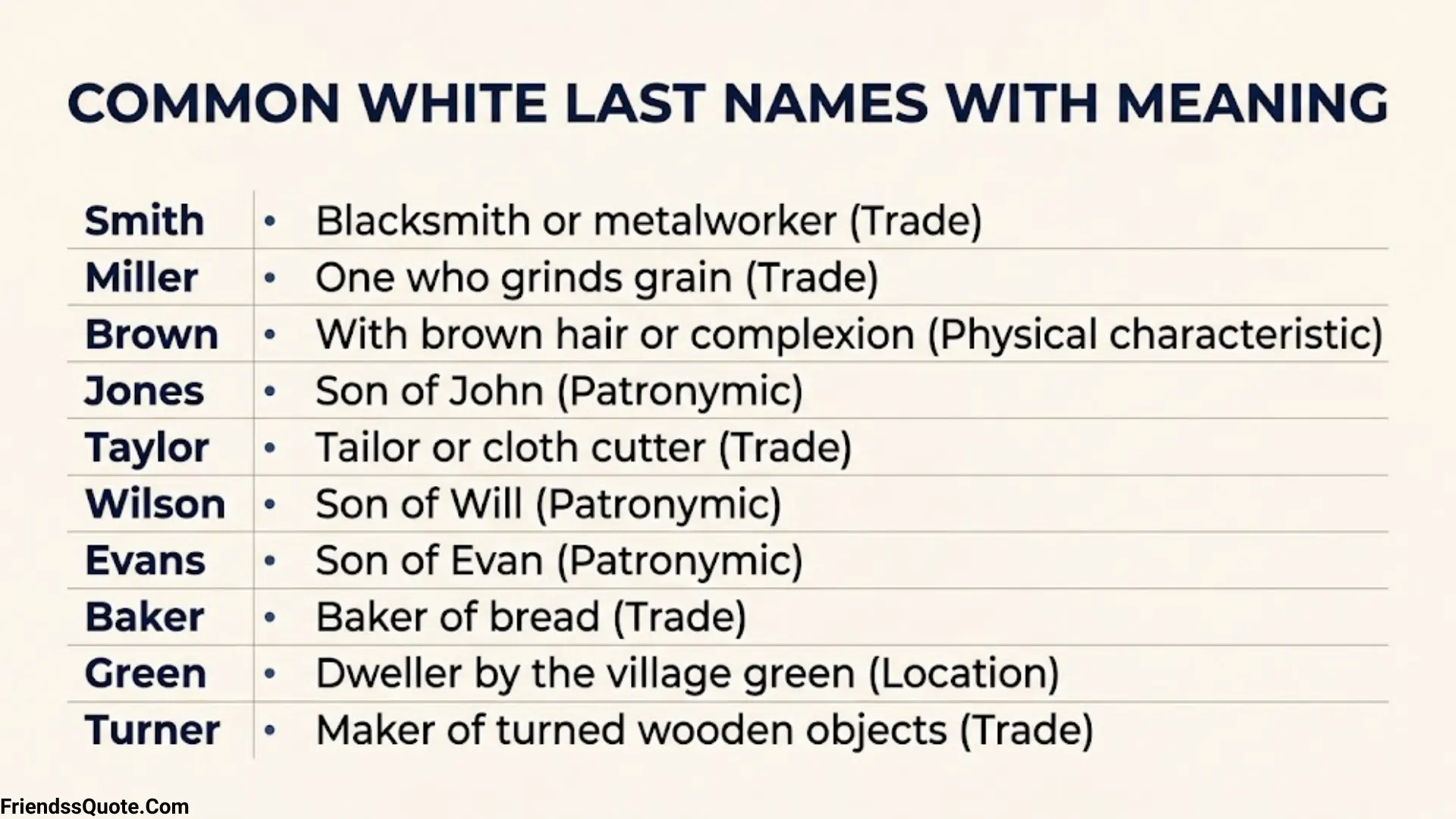
Many familiar surnames developed from everyday occupations, personal names, places, or descriptive words. Their meanings can help explain how family names developed, although a surname’s general etymology does not establish the history of a particular family.
Occupational Surnames
Occupational surnames originally identified a person’s work or trade. Many remain familiar because the occupations behind them were common in earlier communities. The Society for Name Studies in Britain and Ireland documents occupational surnames such as Baker, Carter, Clark, Miller, Smith, Taylor, and Wright.
- Baker — English — An occupational surname for someone who baked bread or other food.
- Carter — English and Irish usage — Traditionally associated with transporting goods by cart.
- Clark — English and Scottish usage — Derived from a word for a clerk or literate official.
- Mason — English and French-influenced usage — An occupational surname associated with stonework.
- Miller — English, Scottish, and German usage — Often connected with someone who operated a grain mill.
- Smith — English and Scottish usage — Traditionally referred to a metalworker, including a blacksmith.
- Taylor — English and French-influenced usage — An occupational surname for a tailor.
- Wright — English and Scottish usage — Historically referred to a maker or builder, often someone who worked with wood.
These names are not limited to one racial or ethnic group. They developed from occupations and words that existed in particular languages and communities.
Surnames Derived From Personal Names
Some family names developed from a parent’s or ancestor’s given name. These are often called patronymic surnames. Their original forms could mean “son of” or indicate descent from someone with a particular first name.
- Anderson — Scottish and Scandinavian usage — A patronymic surname meaning “son of Andrew.”
- Bennett — English usage — Derived from the medieval personal name Benedict, ultimately associated with the Latin word for “blessed.”
- Harrison — English — A patronymic surname meaning “son of Harry.”
- Jackson — English and Scottish usage — A patronymic surname meaning “son of Jack.”
- Morrison — Scottish and Irish usage — Commonly interpreted as “son of Morris.”
- Thompson — English and Scottish usage — A patronymic surname meaning “son of Thomas.”
- Wilson — English and Scottish usage — A patronymic surname meaning “son of Will” or “son of William.”
The same surname may have developed independently in more than one region. Its exact origin can depend on the family’s language, location, and historical records.
Surnames Connected to Places or Nature
Some surnames identify a landscape, settlement, or natural feature. Others have descriptive origins that developed over generations.
- Ainsworth — English — A place-derived surname associated with locations in England.
- Brooks — English — Often associated with a brook or small stream.
- Fairchild — English — Formed from the words “fair” and “child,” though the historical surname’s development may vary.
- Maxwell — Scottish — A place-derived surname associated with a location in Scotland.
- Middleton — English — A place-based surname found in multiple English locations.
- Sinclair — Norman French and Scottish usage — Associated with the place name Saint-Clair.
- Wadsworth — English — A place-derived surname connected with English place names.
These meanings are useful starting points, not complete family histories. If you are researching your own surname, compare a surname dictionary’s explanation with records from the area where your ancestors lived.
Common White Last Names in America
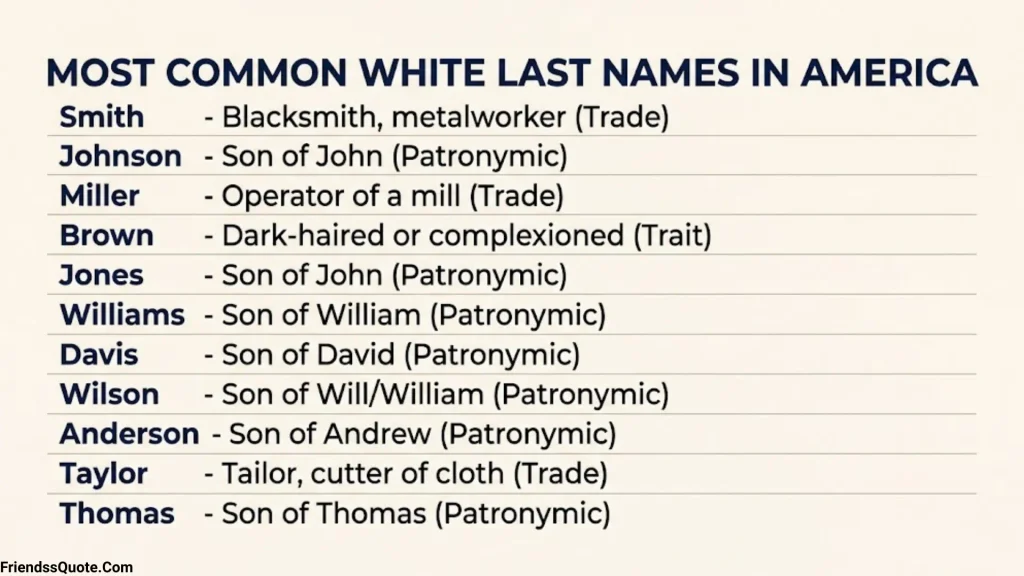
The most common American surnames include names with several different linguistic and cultural backgrounds. According to the U.S. Census Bureau’s 2020 surname data, Smith, Johnson, Williams, Brown, and Jones were the five most common surnames in the country. These five also held the same positions in the 2000 and 2010 censuses.
The Census Bureau also reports that eight surnames appeared in the top 15 in 1790 and remained in the top 15 in 2020: Brown, Davis, Johnson, Jones, Miller, Smith, Williams, and Wilson.
These long-running patterns reflect the history and distribution of surnames in the United States. They do not mean that every person with one of these names has the same background.
Other surnames found widely in American life include:
- Allen
- Campbell
- Collins
- Edwards
- Evans
- Foster
- Hughes
- Parker
- Phillips
- Stewart
This is an illustrative selection, not a precise ranking. To compare surname frequency by year or population group, use the Census Bureau’s published tables rather than relying on a general internet list. Its 2020 surname data include national counts and breakdowns by race and Hispanic origin.
Rich White Last Names
Some surnames are associated with wealthy or influential American families because of documented histories in business, industry, finance, philanthropy, or politics. People may also search for these names when choosing a character surname or exploring family history.
A surname itself does not mean “rich,” and sharing a surname with a famous family does not prove a connection. The following examples refer to recognized historical family associations.
- Astor — European-origin family name — Associated with a prominent American family historically connected with trade and real estate.
- Carnegie — Scottish-origin name — Widely associated with industrialist and philanthropist Andrew Carnegie.
- Du Pont — French-origin name — Associated with the family behind the DuPont chemical business.
- Hearst — English-origin surname — Associated with the American publishing family founded by William Randolph Hearst.
- Mellon — Irish and Scottish usage — Associated with the prominent American Mellon family, known for banking, business, and philanthropy.
- Rockefeller — German-origin surname — Associated with the American family known for oil-industry wealth and philanthropy.
- Vanderbilt — Dutch-origin surname — Associated with the family whose fortune grew through shipping and railroads.
These are examples of historically prominent families, not a ranking of the wealthiest people or families today. The names also have meanings and histories beyond their American associations.
If you are researching whether your family is connected to one of these lineages, look for documented relationships across generations. A shared surname is not enough to establish a connection.
Uncommon White Last Names
Some surnames stand out because they are less familiar in everyday American life or have distinctive spellings. However, uncommon does not necessarily mean statistically rare. A name may be unusual in one state or country and more familiar in another.
The examples below have European linguistic or place-name associations:
- Beauchamp — French and English usage — A place-derived surname built from French elements commonly interpreted as “beautiful field” or “beautiful plain.”
- Hollingsworth — English — A place-based surname associated with English place names.
- Kensington — English — A surname also known from the London place name; a particular family’s origin needs separate evidence.
- Montgomery — Norman French and British usage — A place-derived surname with historical Norman connections.
- Pemberton — English — A place-based surname associated with English locations.
- Thornbury — English — A place-derived surname connected with places bearing that name.
- Winthrop — English — A surname associated with English place names and familiar from early American history.
- Wycliffe — English — A place-derived surname associated with English locations.
These names may suit readers looking for distinctive surnames for fiction or for an initial family-history search. If you need to establish how rare a surname is, check frequency data for the specific country or region.
Common White Last Names in the 1800s
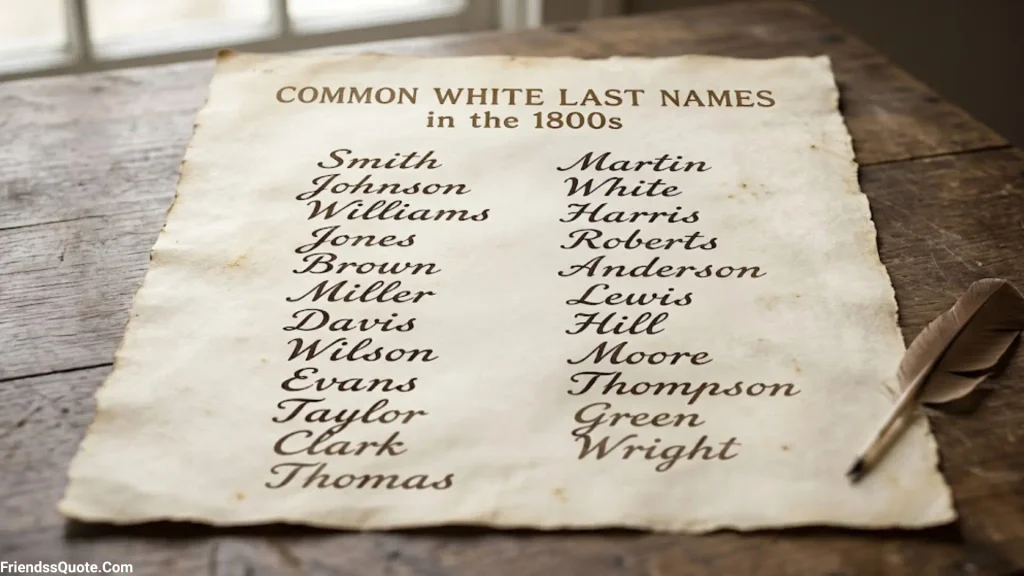
Surnames found in 19th-century American records can help genealogists trace households, migrations, marriages, and family relationships. However, a list of historically used names is not automatically a list of the most common names of the entire century.
Here are additional surname examples to investigate in 1800s records. They are illustrative examples, not a verified century-wide ranking.
- Baldwin — English and German usage — A surname derived from the personal name Baldwin.
- Barrett — English and Irish usage — Has multiple possible historical origins.
- Chandler — English — Traditionally associated with a candle maker or seller.
- Dawson — English — A patronymic surname derived from the personal name Daw, a medieval form related to David.
- Ellis — Welsh and English usage — Derived from a personal name related to Elijah.
- Gardner — English and Scottish usage — An occupational surname associated with gardening or tending land.
- Henderson — Scottish and English usage — A patronymic surname meaning “son of Henry” or a related form, depending on the family history.
- Lawrence — English and other European usage — Derived from the personal name Lawrence.
- Prescott — English — A place-derived surname associated with places in England.
- Sullivan — Irish — An Irish surname with a Gaelic linguistic history.
The United States conducted its first federal population census in 1790 and has conducted a census every ten years since. The National Archives makes historical federal census schedules from 1790 through 1950 available for genealogical research.
When tracing a surname in the 1800s, start with the closest known ancestor and work backward. Search by full name and location, then compare the results with marriage, birth, death, church, land, or immigration records. Older documents may use spelling variations, so avoid rejecting a potential match based on one letter alone.
Common White Last Names That Start With M
Many surnames beginning with M have English, Scottish, Irish, French, German, or other European-language histories. Here are examples that are distinct from the surname entries in the earlier lists.
- Mackenzie — Scottish — A surname derived from a Gaelic personal name.
- Manning — English and Irish usage — Has more than one possible historical origin.
- Marshall — English and Scottish usage — Historically associated with an official or servant responsible for horses or other duties.
- Matthews — English and Welsh usage — A patronymic surname derived from Matthew.
- Mercer — English and Scottish usage — An occupational surname associated with a textile merchant.
- Merritt — English — A surname with several possible historical explanations and spelling relationships.
- Moffat — Scottish — A place-derived surname associated with Moffat in Scotland.
- Morton — English and Scottish usage — A place-derived surname associated with multiple locations.
- Murray — Scottish and Irish usage — Can have different origins depending on the family and region.
- Musgrave — English — A place-derived surname associated with locations in England.
The letter M alone cannot tell you a surname’s cultural background. To understand a particular name, consider the earliest known spelling, the family’s location, and the language used in the historical records.
How to Research a Surname in Your Family History
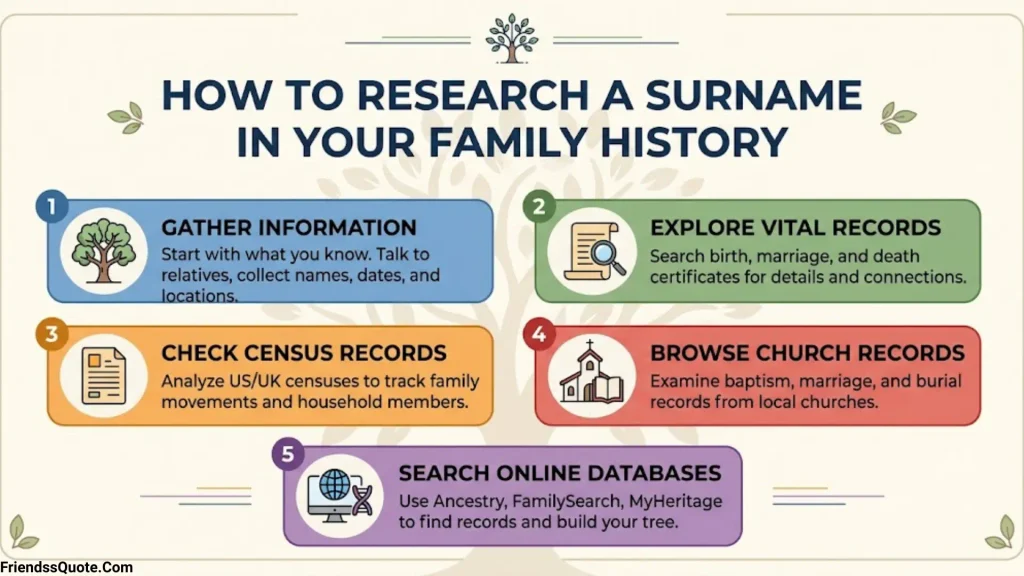
A surname can provide useful clues, but it is only one part of genealogy. To investigate your own family name, follow a few practical steps.
- Start with what you know. Write down relatives’ full names, dates, locations, and any known spelling variations.
- Search historical census records. The U.S. National Archives provides guidance and access to federal census records from 1790 through 1950.
- Compare different records. Birth, marriage, death, church, immigration, and land records may help confirm relationships.
- Check the name’s linguistic history. A reputable surname dictionary can suggest an origin, but it cannot prove your family’s specific ancestry.
- Verify connections across generations. People who share a surname may be unrelated, especially when the surname is common.
For example, finding two people with the same last name in the same county is a useful lead, but it does not prove they were siblings or cousins. Look for records that connect them to the same parents, household, or documented family line.
Frequently Asked Questions
Are there surnames that are exclusively White?
No. Some surnames have European origins or occur frequently among people who identify as White, but surnames can be shared across racial and ethnic groups. A surname alone does not establish a person’s race.
What are the most common last names in America?
The five most common surnames in the 2020 U.S. Census were Smith, Johnson, Williams, Brown, and Jones. The same five names topped the lists in 2000 and 2010.
Can a last name tell you someone’s ancestry?
A surname may offer clues about language or naming traditions, but it cannot prove ancestry. Historical documents and verified links between generations provide stronger evidence.
What are some rich or prestigious-sounding last names?
Astor, Carnegie, Du Pont, Hearst, Mellon, Rockefeller, and Vanderbilt are associated with historically prominent American families. These are family associations, not evidence that everyone with one of those surnames is wealthy or related to those families.
How can I find last names used in the 1800s?
Start with federal or state census records, then compare the names with birth, marriage, death, church, land, and immigration documents. The U.S. National Archives provides access to historical federal census schedules from 1790 through 1950.
What are some common last names that start with M?
Examples include Mackenzie, Manning, Marshall, Matthews, Mercer, Merritt, Moffat, Morton, Murray, and Musgrave. Their origins vary, so consult a surname reference or historical records for more detail.
Does sharing a last name mean two people are related?
No. Surnames can develop independently, and unrelated families can share the same name. A documented connection across generations is needed to establish a family relationship.
Conclusion
Common White last names include many familiar surnames with English, Scottish, Irish, German, French, and other European roots. Names such as Smith, Miller, Anderson, and Taylor reflect different naming traditions, while Rockefeller and Vanderbilt are associated with prominent American families. Whether you’re exploring surname meanings, searching for an uncommon name, or researching surnames from the 1800s, these examples offer a useful starting point.
Remember that a surname alone cannot establish someone’s race, wealth, or family history. If you want to understand your own last name, explore its linguistic origins and compare historical census records with birth, marriage, and immigration documents. These sources can help you move beyond general surname meanings and discover more reliable details about your family’s past.

Patrick Collins is a writer with a passion for meaningful words and timeless quotes that inspire everyday life. He enjoys exploring themes of motivation, relationships, success, and personal growth through simple, relatable writing. Patrick is also the fictional author of Echoes of Quiet Courage and Where Hope Finds Its Voice, two original book concepts created for his author profile. When he’s not writing, he enjoys reading classic literature, traveling, and collecting memorable quotes. His goal is to share words that encourage, uplift, and leave a lasting impression.
 Brianna Lewis