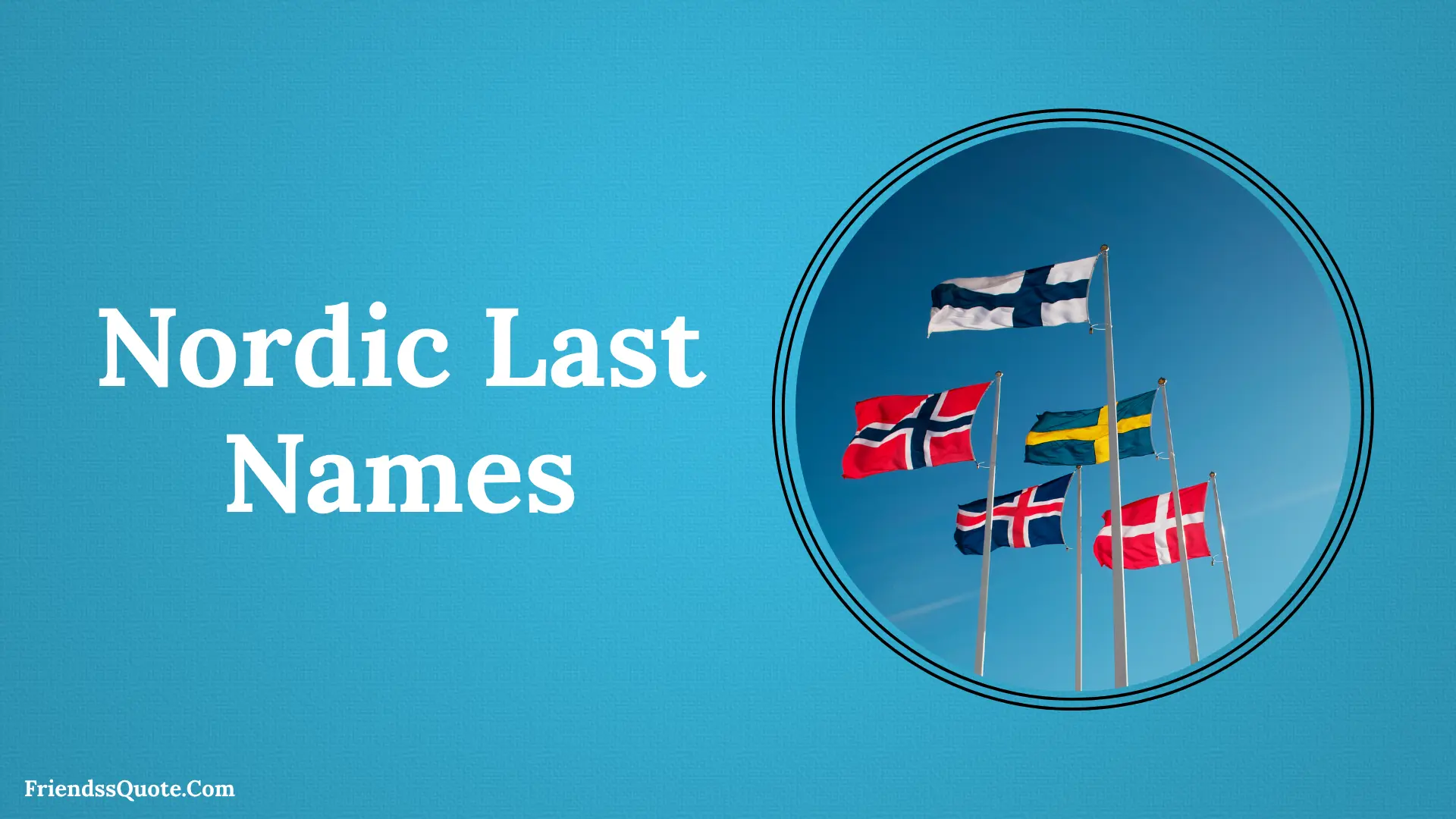
Nordic last names reflect centuries of family traditions, local landscapes, personal names, and regional languages. From familiar Scandinavian surnames such as Andersson, Hansen, and Nielsen to Finnish names such as Virtanen and Korhonen, each naming tradition has its own history.
If you’re researching your family tree, choosing a surname for a character, or simply looking for a distinctive name, understanding these differences will help you find a better fit. Some Nordic surnames developed from a parent’s first name, while others came from farms, geographical features, or older family names.
In this guide, I’ll explain how Nordic last names work, share their meanings and origins, and explore common, rare, old, and cool surname ideas. You’ll also find suggestions for male and female characters, fantasy settings, and Skyrim-inspired names.
How Do Nordic Last Names Work?
Nordic last names don’t follow one universal naming system. Denmark, Norway, Sweden, Finland, and Iceland have different linguistic and historical traditions, even though their naming practices sometimes overlap.
Many traditional Scandinavian surnames began as patronymics, meaning names based on a parent’s given name. Other surnames refer to a family’s home, a landscape, or an inherited family identity. Finland also has distinctive Finnish-language surname traditions, while Iceland continues to use patronymics and metronymics in ways that differ from most neighboring countries.
Patronymic and Metronymic Surnames
A patronymic is a name derived from a father’s name. A metronym is derived from a mother’s name.
In many traditional Scandinavian naming systems, children received names based on a parent’s first name, often with an ending indicating a family relationship.
Examples include:
- Andersson — traditionally, son of Anders.
- Johansson — traditionally, son of Johan.
- Hansen — son of Hans.
- Nielsen — son of Niels or Nils, depending on the language and spelling.
- Eriksen — son of Erik.
- Olsen — son of Ole or a related Scandinavian form.
Historically, a patronymic could change from one generation to the next. A man named Erik might have a son whose surname was Eriksen and a daughter whose name followed the local naming convention for daughters.
Today, however, these names often function as inherited family surnames. Someone named Andersson doesn’t necessarily have a father named Anders.
Iceland preserves a particularly clear example of the older system. A son might have a surname ending in -son, while a daughter might have one ending in -dóttir. These endings identify a relationship to a parent rather than necessarily indicating a permanent family surname shared by every generation.
Family Names, Nature Names, and Farm Names
Not every Nordic surname comes from a parent’s given name.
Many Scandinavian surnames reflect the landscape or a place associated with a family. In Norway, for example, farm names became an important source of surnames. People might be identified by the farm where they lived, and spellings could change as families moved or records were written differently.
Here are several examples:
- Berg — mountain or hill in Scandinavian and related Germanic language contexts.
- Lund — grove, associated with Old Norse lundr.
- Dahl — commonly associated with dal, meaning valley.
- Strand — shore or beach.
- Holm — an island or small island in relevant Scandinavian place-name contexts.
- Lind — associated with the linden or lime tree in Scandinavian languages.
- Berglund — a Swedish surname combining elements meaning mountain and grove.
These meanings can make Nordic surnames appealing to readers who like names connected to nature. However, a word’s literal meaning doesn’t automatically establish the exact origin of a particular family’s surname.
Nordic vs. Scandinavian Naming Traditions
The terms Nordic and Scandinavian are related, but they aren’t identical.
| Term | Countries generally included | Naming considerations |
| Scandinavian | Denmark, Norway, Sweden | Strong historical connections among North Germanic languages and patronymic traditions |
| Nordic | Denmark, Norway, Sweden, Finland, Iceland | Includes additional languages and distinct regional naming systems |
| Icelandic | Iceland | Patronymics and metronymics remain important in modern naming |
| Finnish | Finland | Finnish-language surnames often feature landscape-related roots and the suffix -nen |
Finnish surnames deserve particular attention because they don’t all follow the same patterns as Danish, Norwegian, and Swedish surnames. Names such as Virtanen and Mäkinen reflect Finnish-language traditions rather than simply being variations of Scandinavian names.
Nordic Last Names With Meanings
Nordic surnames can refer to ancestors, geographical features, plants, settlements, and other elements of everyday life. The following examples combine familiar Scandinavian names with selected Finnish and Icelandic forms.
Meanings below describe common linguistic interpretations, not guaranteed genealogical origins for every family bearing the name.
Surnames That Mean Son of Someone
These names are useful examples of the patronymic tradition.
| Nordic last name | Common linguistic interpretation | Regional association |
| Andersson | Son of Anders | Sweden |
| Johansson | Son of Johan | Sweden |
| Karlsson | Son of Karl | Sweden |
| Eriksson | Son of Erik | Sweden |
| Hansen | Son of Hans | Norway, Denmark |
| Johansen | Son of Johan | Norway |
| Olsen | Son of Ole or a related form | Norway |
| Larsen | Son of Lars | Norway, Denmark |
| Nielsen | Son of Niels | Denmark |
| Jensen | Son of Jens | Denmark |
| Pedersen | Son of Peder or Peter-related forms | Denmark, Norway |
| Nilsen | Son of Nils | Norway |
These surnames are particularly useful for understanding why so many Nordic names have similar endings. The personal-name roots differ, but the naming structure repeats across families and regions. Official Norwegian surname statistics and Swedish surname records document many of these names among the country’s established surnames.
Nature Inspired Nordic Surnames
If you like names associated with mountains, forests, water, and northern landscapes, these surnames are worth exploring.
| Surname | Common meaning or association | Style |
| Berg | Mountain or hill | Strong and simple |
| Lund | Grove | Short and understated |
| Dahl | Valley | Classic |
| Strand | Shore | Coastal |
| Holm | Small island or island-related place name | Compact |
| Lind | Linden tree | Soft and traditional |
| Berglund | Mountain and grove elements | Distinctive |
| Lindberg | Linden and mountain elements | Familiar Scandinavian style |
| Lundberg | Grove and mountain elements | Traditional |
| Solberg | Sun and mountain elements | Bright, striking sound |
| Sandvik | Sand and bay or inlet elements | Coastal |
| Nygård | New farm or homestead | Place-based |
Some compound surnames combine familiar landscape words, but their exact historical formation can vary. Treat the word components as clues rather than proof of a family’s original home or occupation.
Surnames Connected to Places and Landscapes
Many Nordic family names originated as geographical identifiers or developed from place names.
- Haugen — associated with a hill or mound.
- Hagen — can be associated with an enclosed area or garden, depending on linguistic and historical context.
- Bakke — slope or hillside in Norwegian contexts.
- Berge — associated with a mountain or hill.
- Eide — a Norwegian place-name element often associated with an isthmus or narrow connecting strip of land.
- Vik — bay or inlet in Scandinavian place-name contexts.
- Lie — associated with a hillside or slope in Norwegian surname contexts.
- Solheim — commonly interpreted through elements meaning sun and home or homestead.
- Lunde — a form related to lund, meaning grove.
- Nygård — new farm or homestead.
These names may appeal to anyone seeking a surname with a natural or geographical association. If you’re researching an actual ancestor, compare the surname with historical locations and original records before deciding which interpretation applies.
Finnish Surnames and Their Meanings
Finland adds another important dimension to Nordic surname research. Finnish-language surnames frequently use roots associated with landscapes, nature, and places.
| Finnish surname | Meaning or interpretation |
| Virtanen | Related to virta, meaning stream or current |
| Mäkinen | Related to mäki, meaning hill |
| Nieminen | Related to niemi, meaning peninsula or headland |
| Järvinen | Related to järvi, meaning lake |
| Koskinen | Related to koski, meaning rapids |
| Hämäläinen | Associated with Häme, a historical region of Finland |
| Heikkinen | A surname formed from the given name Heikki |
| Korhonen | A common Finnish surname whose deeper origin is uncertain or disputed |
The ending -nen is common in Finnish surnames. Although it can function as a diminutive in Finnish, surname formation often connects it with a place or family association rather than a simple literal translation. The Finnish government publication ThisisFINLAND discusses these naming patterns and cautions against treating every surname as a straightforward dictionary phrase.
Common and Popular Nordic Last Names
Some Nordic surnames appear frequently in official national statistics. Their popularity varies by country, so there is no single universal ranking that accurately describes every Nordic population.
Common Swedish Last Names
Sweden’s official surname statistics list the following names among the country’s most common surnames in the 2021 dataset:
- Andersson
- Johansson
- Karlsson
- Nilsson
- Eriksson
- Larsson
- Olsson
- Persson
- Svensson
- Gustafsson
- Pettersson
- Jonsson
- Jansson
- Hansson
- Bengtsson
These names illustrate the strong presence of surnames ending in -son in Sweden. The Swedish statistics agency also notes regional differences in which surname ranks first. Its published 2021 list is a historical snapshot rather than a current 2026 ranking.
Common Norwegian and Danish Last Names
Norwegian surname statistics include Hansen, Johansen, Olsen, Larsen, Andersen, Pedersen, Nilsen, Kristiansen, Jensen, and Karlsen among prominent surnames.
In Denmark, Nielsen, Jensen, Hansen, Andersen, and Pedersen are familiar examples. A 2026 surname dataset published by Statista identifies Nielsen as Denmark’s most common surname at the start of that year.
The spellings sometimes reveal regional differences. For example, Nilsen is common in Norway, while Nielsen is a familiar Danish form. Both belong to the broader family of surnames derived from Nils or Niels.
Common Finnish and Icelandic Naming Patterns
Finnish surnames such as Korhonen, Virtanen, Nieminen, Mäkinen, Hämäläinen, Koskinen, Heikkinen, and Järvinen are well-established examples of Finnish-language naming traditions.
Iceland requires a different approach. Many Icelanders use a surname based on a parent’s name rather than a hereditary family surname. The official Icelandic government guidance gives examples such as Gunnarsson and Gunnarsdóttir, as well as names formed from a mother’s given name.
Consequently, a common surname in Sweden or Denmark may represent an inherited family name, while a similar-looking Icelandic name may identify a parent-child relationship.
Unique Scandinavian Last Names
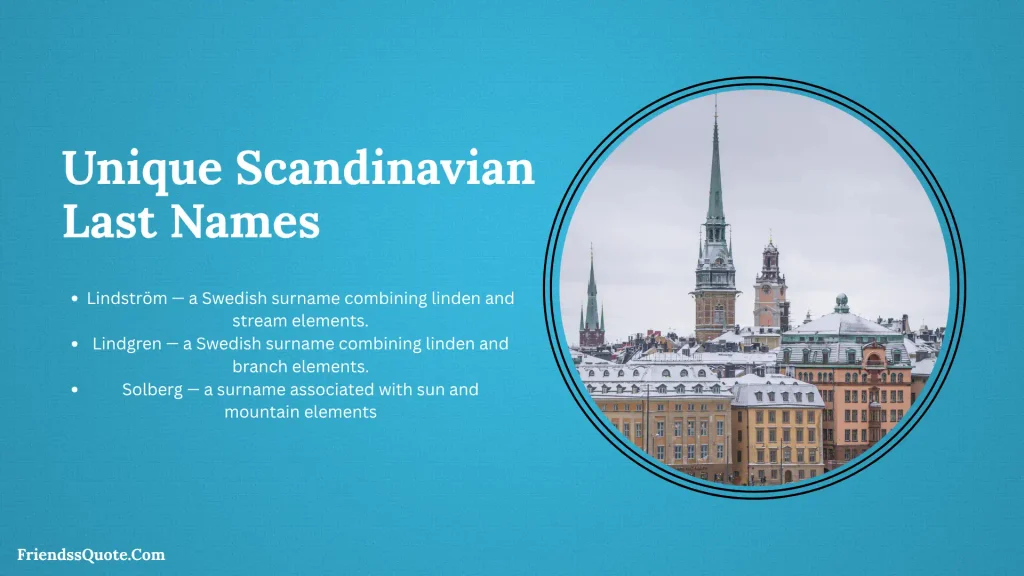
A unique surname doesn’t have to be rare in its country of origin. It may simply have a distinctive sound, an interesting meaning, or an uncommon appearance to English-speaking readers.
Here are some authentic surnames worth considering:
- Berglund — a Swedish surname combining mountain and grove elements.
- Lindqvist — a Swedish surname with elements associated with linden and a twig or branch.
- Lindström — a Swedish surname combining linden and stream elements.
- Lindgren — a Swedish surname combining linden and branch elements.
- Solberg — a surname associated with sun and mountain elements.
- Haugland — a Norwegian surname with elements associated with a mound or hill and land.
- Sandvik — a Scandinavian place-based surname associated with sand and a bay or inlet.
- Nygård — a Scandinavian surname associated with a new farm or homestead.
- Sæther — a Norwegian surname connected with a sæter or mountain pasture.
- Birkeland — a Norwegian surname associated with birch and land.
- Koskinen — a Finnish surname connected with rapids.
- Hämäläinen — a Finnish surname associated with the region of Häme.
These are examples of distinctive names, not a verified statistical list of the rarest Scandinavian surnames. To establish rarity, you’d need current surname-frequency data for the relevant country.
Rare Scandinavian Surnames
Rare Scandinavian surnames can be appealing for genealogy research, historical fiction, or naming a character. However, rarity depends on the country, the date of the records, and the spelling used.
Consider researching these less familiar options:
| Surname | Regional association | Meaning or background |
| Aas | Norway | Associated with a ridge or elevated place |
| Eide | Norway | A geographical name element |
| Moen | Norway | Often associated with a meadow or sandy plain in place names |
| Myhre | Norway | A place-based surname with regional spelling history |
| Rønning | Norway | Associated with a clearing or cultivated place in Norwegian name traditions |
| Sæther | Norway | Connected with a mountain pasture or seasonal farm |
| Næss | Norway | Related to a headland or promontory |
| Haugland | Norway | A compound place-based surname |
| Nygård | Norway, Denmark, Sweden | New farm or homestead elements |
| Bergström | Sweden | Mountain and stream elements |
The meaning of a place-based surname can depend on its specific origin. A person whose family name appears on this list may descend from a family associated with a particular farm, settlement, or geographical feature.
For a genuinely rare surname, search national statistics and historical records. Don’t rely on a website’s label of “rare” without knowing what population it measured.
Old and Ancient Nordic Last Names
Old Nordic names require some historical context. During the Viking Age and medieval period, people did not always use permanent inherited surnames in the modern sense. Patronymics, descriptive bynames, nicknames, and place names helped distinguish individuals.
Scholarly work on Old Norse naming describes how these names could express family relationships and individual characteristics. A historical byname might refer to appearance, behavior, ancestry, or a notable event, although the reason for a particular nickname isn’t always certain.
Old Nordic Names Based on Ancestry
Names formed from a parent’s given name are among the most recognizable historical naming patterns.
Examples include:
- Eriksson — son of Erik.
- Olsson — son of Olav, Ole, or a related form, depending on regional tradition.
- Hansson — son of Hans.
- Andersson — son of Anders.
- Sigurðsson — son of Sigurður in Icelandic naming.
- Sigurðardóttir — daughter of Sigurður in Icelandic naming.
These examples illustrate naming structures that have historical roots, but the presence of a patronymic ending alone doesn’t prove that a particular spelling was used by a Viking Age individual.
Ancient Norse Bynames and Historical Names
For a character inspired by medieval Norse culture, descriptive bynames may be more historically appropriate than treating every name as a modern family surname.
Historical naming traditions included names and bynames connected to features, animals, colors, or personal reputations. However, modern fantasy lists often mix genuine historical names, later surnames, and invented forms.
For accurate historical research, consult specialist Old Norse name dictionaries, medieval texts, and academic studies. The University of Minnesota’s publication of Paul R. Peterson’s research on Old Norse nicknames is a useful starting point.
Cool Nordic Last Names
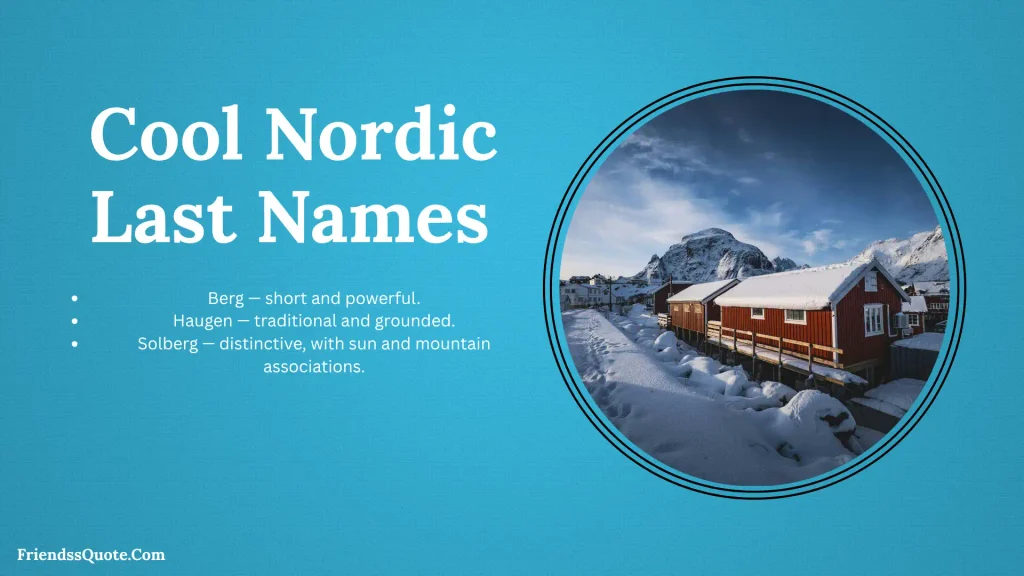
Some Nordic surnames sound bold, others elegant, and others bring natural landscapes to mind. The best choice depends on the atmosphere you’re aiming for.
Strong Sounding Nordic Surnames
- Berg — short and powerful.
- Haugen — traditional and grounded.
- Solberg — distinctive, with sun and mountain associations.
- Sandvik — strong, coastal character.
- Lindström — recognizable Swedish surname structure.
- Haugland — a substantial, place-based surname.
- Strand — brief and direct.
- Bakke — compact and easy to spell.
Elegant Nordic Surnames
- Lindgren — familiar Swedish surname with natural elements.
- Berglund — balanced and distinctive.
- Lund — simple and understated.
- Nygård — traditional Scandinavian spelling.
- Lindqvist — visually distinctive.
- Solheim — smooth sound and a place-based background.
- Vik — concise and easy to remember.
Short Nordic Last Names
If you prefer a surname that’s easy to pronounce in English, these options are worth considering:
- Berg
- Lund
- Lind
- Vik
- Dahl
- Holm
- Aas
- Lie
- Moe
- Eide
Pronunciation may vary between Nordic languages and English. If you’re choosing a surname for a real person, check the original-language pronunciation rather than relying only on how the spelling looks.
Nordic Last Names for Males and Girls
People often search for male or female Nordic last names when choosing a character name or looking for a particular style. The key distinction is that most modern inherited Scandinavian surnames are not restricted to one gender.
Andersson, Berg, Lund, Hansen, and Dahl can appear as family surnames regardless of whether the person bearing them is male or female.
Nordic Last Names for Males
If you’re looking for a masculine-sounding surname for a character, these established names offer several styles:
| Surname | Style | Background |
| Berg | Strong and compact | Mountain or hill |
| Eriksson | Traditional | Patronymic from Erik |
| Hansen | Classic | Patronymic from Hans |
| Solberg | Bold | Place-based elements |
| Haugland | Stately | Norwegian place-name tradition |
| Strand | Clean and direct | Shore |
| Sandvik | Rugged | Coastal place-name elements |
| Lindström | Distinctive | Swedish compound surname |
These are style suggestions, not surnames that belong exclusively to men.
Nordic Last Names for Girls
The same principle applies to feminine character names. Many established Nordic surnames can be used by characters of any gender.
Consider these options for a softer, elegant, or nature-inspired sound:
- Lind
- Lund
- Dahl
- Berglund
- Lindgren
- Solheim
- Strand
- Nygård
If you want a historically gender-specific form, Icelandic patronymics and metronymics provide clearer examples. A daughter of someone named Sigurður may be named Sigurðardóttir, while a son may be named Sigurðsson. These forms refer to the parent and should not be confused with the ordinary gender-neutral use of inherited surnames elsewhere in the Nordic region.
Nordic Last Names for Fantasy Characters
Nordic-inspired surnames work well in fantasy because they can evoke forests, mountains, coastlines, old settlements, and medieval northern cultures. You can create a convincing name without inventing a false historical meaning for a real surname.
Authentic Surnames for Fantasy Characters
These real surnames can suit a range of characters:
- Berg — a warrior, scout, or mountain-dwelling character.
- Solberg — a noble, explorer, or leader.
- Lindgren — a scholar, healer, or forest dweller.
- Sandvik — a sailor, merchant, or coastal traveler.
- Haugland — a landowner or village leader.
- Strand — a seafarer or islander.
- Lund — a quiet, scholarly, or nature-connected character.
- Nygård — a settler or member of a farming community.
These associations are creative suggestions, not historical facts about the people who bear those surnames.
How to Create a Nordic Inspired Fantasy Surname
Start by deciding whether you want a historically grounded name or a fictional one.
- Choose a cultural influence. Swedish, Norwegian, Danish, Finnish, and Icelandic names have different patterns.
- Select a meaningful element. A real landscape word or documented surname can give your character a clear connection to place.
- Keep the spelling consistent. Don’t combine language elements randomly if historical authenticity matters.
- Label inventions honestly. A fictional surname inspired by Nordic languages isn’t automatically an authentic Norse surname.
- Check existing names. If your story is based on an established game or book, make sure the name doesn’t accidentally duplicate a major character.
For original fantasy, you can invent a surname that feels northern in tone, but avoid presenting it as an attested historical family name unless you have evidence for that claim.
Nordic Last Names in Skyrim
The Elder Scrolls V: Skyrim draws on northern European and Norse-inspired imagery, so Nordic-style names can fit naturally into a character-building project. However, the game’s fictional culture isn’t a complete representation of historical Scandinavia.
Choosing a Skyrim-Inspired Surname
For a player-created character, authentic Scandinavian surnames such as Berg, Lund, Strand, and Solberg can create a grounded northern atmosphere.
If you prefer a name closer to the game’s fantasy tone, consider how the surname sounds alongside your character’s first name, race, background, and role.
For example, these are original name combinations, not claims about official game characters:
- Erik Berg — a straightforward northern-style character name.
- Astrid Solberg — a nature-inspired fantasy name.
- Leif Strand — a coastal or seafaring character.
- Freya Lind — a short, elegant name.
- Soren Haugland — a grounded, traditional-sounding combination.
Use authentic surnames when you want a recognizable cultural connection. For a lore-focused character, compare your choice with established names in the game and its official reference material. Avoid assuming that every surname that sounds Nordic belongs to the game’s canonical naming system.
List of Nordic Last Names
The following list brings together surnames from the Nordic region. It includes established Scandinavian family names, Finnish surnames, and selected Icelandic patronymic forms.
Meanings are included where a common linguistic interpretation is reasonably clear. A surname’s exact family history may differ from its literal meaning.
| Nordic last name | Regional association | Meaning or origin |
| Andersson | Sweden | Son of Anders |
| Andersen | Denmark, Norway | Son of Anders |
| Johansson | Sweden | Son of Johan |
| Johansen | Norway | Son of Johan |
| Hansen | Denmark, Norway | Son of Hans |
| Hansson | Sweden | Son of Hans |
| Karlsson | Sweden | Son of Karl |
| Eriksson | Sweden | Son of Erik |
| Eriksen | Norway, Denmark | Son of Erik |
| Larsson | Sweden | Son of Lars |
| Larsen | Norway, Denmark | Son of Lars |
| Olsson | Sweden | Son of a form such as Olof or Olav |
| Olsen | Norway | Son of Ole or a related form |
| Persson | Sweden | Son of Per |
| Pedersen | Denmark, Norway | Son of Peder |
| Nielsen | Denmark | Son of Niels |
| Nilsen | Norway | Son of Nils |
| Svensson | Sweden | Son of Sven |
| Berg | Scandinavia | Mountain or hill |
| Lund | Scandinavia | Grove |
| Lind | Scandinavia | Linden tree |
| Dahl | Scandinavia | Valley-related name |
| Strand | Scandinavia | Shore |
| Holm | Scandinavia | Island-related name |
| Vik | Scandinavia | Bay or inlet |
| Bakke | Norway | Slope or hillside |
| Haugen | Norway | Hill or mound |
| Hagen | Norway and neighboring regions | Place-name surname; interpretation varies |
| Eide | Norway | Geographical name element |
| Lie | Norway | Hillside or slope association |
| Moen | Norway | Place-based surname |
| Myhre | Norway | Place-based surname |
| Rønning | Norway | Clearing-related place name |
| Sæther | Norway | Mountain pasture or seasonal farm |
| Solheim | Norway | Sun and home or homestead elements |
| Haugland | Norway | Hill or mound and land elements |
| Sandvik | Norway, Sweden | Sand and bay or inlet elements |
| Nygård | Nordic region | New farm or homestead |
| Berglund | Sweden | Mountain and grove |
| Lindberg | Sweden | Linden and mountain |
| Lindström | Sweden | Linden and stream |
| Lindgren | Sweden | Linden and branch |
| Virtanen | Finland | Stream-related root |
| Korhonen | Finland | Deeper origin uncertain or disputed |
| Nieminen | Finland | Peninsula or headland-related root |
| Mäkinen | Finland | Hill-related root |
| Järvinen | Finland | Lake-related root |
| Koskinen | Finland | Rapids-related root |
| Hämäläinen | Finland | Associated with Häme |
| Heikkinen | Finland | Derived from the given name Heikki |
| Sigurðsson | Iceland | Son of Sigurður |
| Sigurðardóttir | Iceland | Daughter of Sigurður |
| Gunnarsson | Iceland | Son of Gunnar |
| Gunnarsdóttir | Iceland | Daughter of Gunnar |
This list is a practical starting point, not a complete catalogue of Nordic surnames or a ranking of their popularity. It also combines several naming systems, so the country label and the distinction between inherited surnames and patronymics matter.
How to Choose or Generate a Nordic Surname
A good Nordic surname depends on your goal. If you’re researching ancestry, accuracy matters more than how dramatic the name sounds. If you’re writing fiction, style and cultural consistency may be more important.
For Family History and Genealogy
Use these steps to investigate a surname:
- Identify the likely country. Start with Sweden, Norway, Denmark, Finland, or Iceland based on known family records.
- Record older spellings. Historical documents may use different spellings, regional forms, or older characters.
- Look for original records. Birth, marriage, census, immigration, and church records can help connect a name to a particular person or location.
- Check the meaning carefully. A dictionary definition is useful, but it doesn’t establish why one specific family adopted the name.
- Compare relatives and locations. A shared surname alone doesn’t prove that two people belong to the same family.
For names containing characters such as å, ä, ö, æ, or ð, retain the original spelling when records support it. Transliteration and migration can produce alternative forms, and those differences may matter in genealogical searches.
For a Nordic Surname Generator
A surname generator can be useful for brainstorming, but it should distinguish authentic surnames from fictional combinations.
Try this simple approach:
- Choose a country or language tradition.
- Select a style: traditional, short, nature-inspired, rare-sounding, or fantasy.
- Decide whether the name must be historically documented.
- Check the meaning and spelling before using it.
- Keep invented names labeled as fictional.
For example, if you choose a nature-inspired style, Berg, Lund, and Strand are established options. If you choose an Icelandic historical style, you should consider how patronymics and metronymics are formed rather than simply adding -son to any first name.
The best generator is one that offers clear choices and explains whether a result is an attested surname, a constructed name, or a fictional suggestion.
Frequently Asked Questions
What Is the Most Common Nordic Last Name?
There isn’t one universally accepted answer because Nordic countries maintain separate surname statistics. Andersson was the most common surname in Sweden in the official 2021 dataset, while Nielsen ranked first in Denmark in a 2026 dataset. Norway has its own ranking, in which Hansen is a leading surname.
Are Nordic Surnames Gender-Specific?
Most modern inherited surnames in Sweden, Norway, and Denmark are used by people of different genders. Iceland is an important exception to the general pattern because patronymic and metronymic forms can differ, such as -son and -dóttir.
What Does -Son Mean in Nordic Surnames?
The ending -son historically means “son of” in patronymic names. Andersson, for example, originally identified someone as the son of Anders. In many modern Scandinavian families, these names are inherited surnames and no longer change with each generation.
Are All Nordic Last Names Viking Names?
No. Some Nordic surnames and naming traditions have roots in the Viking Age or medieval period, but many modern surnames developed later from farm names, landscape terms, and hereditary family-name systems. A surname that sounds Nordic isn’t automatically an attested Viking-era name.
How Can I Find My Nordic Surname’s Origin?
Begin with family documents and identify the country or region associated with your ancestors. Compare historical spellings, consult national records and reliable surname references, and investigate places where your family lived. Treat a surname’s literal meaning as a clue rather than proof of a specific ancestral connection.
Conclusion
Nordic last names tell different stories about ancestry, geography, language, and cultural traditions. Names such as Andersson, Hansen, and Nielsen illustrate the history of patronymics, while Berg, Lund, and Strand demonstrate how landscapes influenced surnames. Finnish names and Icelandic patronymics add further regional differences that make the Nordic naming tradition more varied than it may first appear.
If you’re choosing a surname for a character, start with the style and cultural background you want. If you’re tracing your family history, use original records and regional sources to verify what a name means for your particular family. That approach will help you find a Nordic surname that is not only distinctive but also grounded in its real linguistic and historical context.

Patrick Collins is a writer with a passion for meaningful words and timeless quotes that inspire everyday life. He enjoys exploring themes of motivation, relationships, success, and personal growth through simple, relatable writing. Patrick is also the fictional author of Echoes of Quiet Courage and Where Hope Finds Its Voice, two original book concepts created for his author profile. When he’s not writing, he enjoys reading classic literature, traveling, and collecting memorable quotes. His goal is to share words that encourage, uplift, and leave a lasting impression.
 Brianna Lewis