Country last names often reflect a rich history of rural life, family traditions, and cultural heritage. These surnames can be inspired by farms, nature, small towns, and generations of hardworking families. Whether you love rustic names or want to learn about traditional family names, exploring country last names can help you discover meaningful and memorable options.
If you are searching for a country last name for a character, a family tree, or a creative project, you will find plenty of choices with a classic Southern or rural American feel. Some surnames sound strong and traditional, while others have a charming, old-fashioned style. You can explore different names based on their origins, meanings, and the feeling they create.
In this guide, you will discover a variety of country last names, from popular and timeless surnames to rare and distinctive options. Whether you prefer a simple country surname or a name with deep historical roots, this collection will help you find the right fit for your needs.
What Are Country Last Names?
Country last names are surnames associated with rural life, traditional communities, countryside landscapes, farming, ranching, and familiar American country culture. Some refer directly to geographical features or occupations, while others have become associated with Southern families, frontier stories, or Western settings.
For example, Fields, Woods, and Brooks evoke the natural landscape. Baker, Miller, and Carter reflect traditional occupations or ways of life. Names such as McCoy, Dalton, and Walker may suit a country-inspired character, although their histories are not limited to rural America.
Country-style surnames generally fall into several overlapping categories:
- Landscape surnames: Names connected to woods, rivers, valleys, hills, and fields.
- Occupational surnames: Names derived from work, trades, or social roles.
- Traditional family names: Long-established surnames with historical roots.
- Southern-style surnames: Names associated with families and settlement histories across the American South.
- Western-inspired surnames: Names that fit the atmosphere of ranches, frontier stories, and Western fiction.
The categories below are intended to help you find a name that fits your needs. They are not definitive historical classifications.
Country Last Names With Meanings
Many country-style surnames preserve clues about the landscapes, occupations, and personal names of earlier generations. The meanings below describe established word origins where possible, rather than claiming that every family with a particular surname shares the same history.
Nature and Landscape Surnames
These surnames work especially well if you want a rustic, outdoorsy, or countryside feel.
Origin and meaning guide
- Fields — English — Connected to open land or fields.
- Woods — English — Refers to woods or wooded areas.
- Brooks — English — Associated with a brook or small stream.
- Rivers — English and other possible origins — Connected to rivers or river locations.
- Ford — English — Refers to a shallow place where a river or stream can be crossed.
- Dale — English and Scandinavian influences — Associated with a valley.
- Hill — English — A topographical surname for someone associated with a hill.
- Meadows — English — Connected to meadowland.
- Marsh — English — Refers to marshy or wetland areas.
- Wells — English — Often associated with springs or wells.
- Bridges — English — Connected to a bridge or a place near one.
- Hayes — English and Irish origins are possible — May refer to an enclosure or hedged area in English contexts, but other origins exist.
- Glenn — Scottish Gaelic and Irish usage — Associated with a valley or glen.
- Forrest — English and French-influenced history — Connected to a forest or wooded area.
- Ashby — English — A place-name surname built from elements associated with ash trees and a settlement or farmstead.
- Whitfield — English — A place-name surname associated with a white or pale field.
- Greenwood — English — Connected to a green or wooded area.
- Atwood — English — Literally associated with living at or near a wood.
- Underwood — English — Associated with a location beneath or near a wood.
- Westwood — English — A surname associated with a western wood or wooded place.
Occupational and Traditional Surnames
Traditional occupations created many hereditary surnames. These names are particularly suitable if you want a grounded, old-fashioned, or working-country style.
- Baker — English — A surname derived from the occupation of baking bread.
- Miller — English, Scottish, and other European usage — Associated with a person who operated a mill.
- Smith — English and Scottish usage — Derived from the occupation of a metalworker or blacksmith.
- Carter — English — Associated with transporting goods by cart.
- Cooper — English — Refers to a maker of barrels and other wooden vessels.
- Taylor — English and French-influenced usage — Derived from the occupation of a tailor.
- Fletcher — English — Traditionally associated with making arrows.
- Archer — English — Connected to the occupation of an archer.
- Shepherd — English and Scottish usage — Refers to someone who tended sheep.
- Foster — English and other origins are possible — Historically associated in some cases with fostering or caring for children.
- Chandler — English and French-influenced usage — Associated with a maker or seller of candles and other goods.
- Weaver — English — Derived from the occupation of weaving cloth.
- Potter — English — Associated with making pottery.
- Cook — English and Scottish usage — Derived from the occupation of a cook.
- Gardner — English spelling variant of Gardener — Connected to gardening or tending a garden.
- Hayward — English — Historically associated with someone responsible for protecting or supervising enclosed land and crops.
- Wright — English and Scottish usage — Derived from an Old English word for a maker or craftsman.
- Barber — English and Scottish usage — Associated with the occupation of cutting hair and performing related services.
- Mason — English and French-influenced usage — Connected to stonework or masonry.
- Tanner — English and other European usage — Associated with preparing animal hides into leather.
Occupational surnames often developed independently in different places. Two families named Smith, Baker, or Miller do not necessarily share a common ancestor. The surname may reflect a widespread occupation rather than a single founding family.
Country Last Names for Girls
Surnames can make distinctive names for female characters, pen names, or modern first-name combinations. They don’t normally have separate masculine and feminine forms in English, so you can choose based on sound, meaning, and the personality you want.
These options lean toward soft, nature-inspired, classic, or elegant styles.
| Last name | Origin or association | Why it works |
| Harper | English and Scottish usage | Musical, modern, and familiar |
| Willow | English word-name association | Nature-inspired and gentle |
| Rose | English and other European usage | Floral and timeless |
| Lane | English | Short, simple, and understated |
| Ellis | English and Welsh usage | Classic and versatile |
| Quinn | Irish | Short and confident |
| Blair | Scottish | Clean, elegant sound |
| Sutton | English | Traditional and polished |
| Avery | English and French-influenced history | Modern and versatile |
| Cassidy | Irish | Lively and distinctive |
| Monroe | Scottish | Bold, recognizable sound |
| Bailey | English | Friendly and familiar |
| Sawyer | English occupational surname | Outdoorsy and modern |
| Parker | English occupational surname | Casual and adaptable |
| Rowan | Scottish and Irish usage | Nature-associated and contemporary |
Best choices for a country-inspired feel: Harper, Lane, Sawyer, Bailey, Cassidy, and Rowan.
If you’re using a surname as a given name, consider how it sounds with the first name and whether the combination is easy to spell and pronounce.
Country Last Names for Boys
For a traditional masculine character or a boy’s name combination, you might prefer a surname with a strong, classic, or frontier-inspired sound.
| Last name | Origin or association | Why it works |
| Wyatt | English | Familiar in Western-inspired naming |
| Walker | English and Scottish usage | Traditional and sturdy |
| Hunter | English and Scottish usage | Associated with hunting |
| Austin | English and other origins | Short and familiar |
| Cole | English and other origins | Compact and straightforward |
| Jackson | English and Scottish usage | A traditional patronymic surname |
| Cooper | English | Occupational and approachable |
| Brooks | English | Nature-inspired and modern |
| Carson | Scottish and Irish usage | Strong, classic sound |
| Dawson | English | Traditional patronymic style |
| Tucker | English | Casual and country-friendly |
| Mason | English and French-influenced usage | Familiar and contemporary |
| Colton | English | Often used in modern American naming |
| Bennett | English and French-influenced history | Classic and refined |
| Morgan | Welsh and other origins | Established and versatile |
Best choices for a Western character: Wyatt, Walker, Carson, Tucker, and Dawson.
These are style suggestions, not surnames reserved for boys. Every name on the list can be used according to your preference.
Old Country Last Names
Old country last names can give a character or family tree a traditional feel. Many surnames developed from occupations, places, personal names, or nicknames and became hereditary over generations.
The following names have established histories in English or related naming traditions. Their age as surnames varies by family and region.
- Bennett — English and French-influenced history — Derived from the medieval personal name Benedict.
- Clark — English and Scottish usage — Derived from a word for a clerk or literate official.
- Fletcher — English — Historically associated with arrow-making.
- Harrison — English — A patronymic meaning “son of Harry.”
- Lawson — English and Scottish usage — A patronymic meaning “son of Lawrence” or a related form of the name.
- Marshall — English and Scottish usage — Historically associated with a horse servant or an official title.
- Palmer — English — Historically associated with a pilgrim who had visited the Holy Land.
- Reed — English and Scottish usage — May derive from a nickname associated with red hair or complexion, though origins vary.
- Russell — English and French-influenced history — Often associated with an old nickname meaning reddish.
- Turner — English — Derived from an occupation involving turning wood, metal, or other materials.
- Webster — English and Scottish usage — Traditionally associated with weaving.
- Baxter — Scottish and English usage — An occupational surname historically associated with a female baker.
- Chapman — English — An old occupational term for a merchant or trader.
- Dawson — English — A patronymic derived from the personal name Daw or David-related forms.
- Ellis — English and Welsh usage — Derived from a medieval personal name related to Elias.
- Goodman — English and Scottish usage — Historically associated with a term of respect or social standing.
- Holland — English and other European usage — Often associated with a place or regional name.
- Merritt — English — May be associated with a personal name or place-name history, depending on the family.
- Norris — English and French-influenced history — Often associated with a northern location or a person from the north.
- Whitaker — English — A locational surname associated with a white field or a place bearing a related name.
A traditional sound doesn’t prove that a surname is ancient in every family line. If you’re researching your own family, historical records are more useful than a surname’s style alone.
Unique Country Last Names
If you want something less ordinary, consider surnames that are distinctive without being invented or given misleading meanings. Some are uncommon in everyday conversation; others are established surnames that stand out because of their sound.
- Arkwright — English — An occupational surname associated with a maker of chests or wooden containers.
- Ainsworth — English — A local surname associated with places in England.
- Blackwood — English and Scottish usage — Associated with a place or wooded landscape.
- Cavendish — English — A local surname linked to a place in England.
- Culpepper — English — A historical surname with an established English family history.
- Hollingsworth — English — A local surname associated with places bearing related names.
- Kincaid — Scottish — A local surname associated with a place in Scotland.
- Lockwood — English — A local surname associated with places in England.
- Pritchard — Welsh — A patronymic derived from an older personal-name form.
- Thornhill — English — A locational surname associated with a thorn-covered hill or a place of that name.
- Weatherby — English — A local surname associated with places bearing related names.
- Wetherby — English — A place-name surname associated with Wetherby in Yorkshire.
- Hawthorne — English — Connected to the hawthorn plant or a related place-name.
- Rutherford — Scottish and English border-region history — A locational surname associated with a place in the Scottish Borders.
- Hargrove — English — A local surname associated with a grove or a place bearing a related name.
A distinctive surname doesn’t have to be rare to be useful. For a novel, for example, the best choice may be a name that’s easy to remember and fits the character’s background.
Unique Southern Last Names
Southern American surnames reflect many settlement histories, including English, Scots-Irish, Scottish, Irish, German, French, and other influences. The region doesn’t have one exclusive surname system, and a name’s presence in the South does not necessarily mean it originated there
These surnames can suit stories set in the American South or readers looking for traditional Southern associations.
- Beauregard — French — A surname associated with French words meaning “beautiful view.”
- Calhoun — Scottish and Irish usage — Associated with the Scottish surname Colquhoun and its historical place-name origins.
- Boudreaux — French, especially Louisiana French usage — A French surname with regional associations in Louisiana.
- Landry — French and French Canadian usage — Derived from a personal name of Germanic origin.
- Fontenot — French — A surname found in French-speaking communities, including Louisiana.
- Guidry — French and French Canadian usage — A surname with French historical roots.
- McCoy — Irish and Scottish-influenced surname traditions — Often connected with the Gaelic patronymic tradition.
- McAllister — Scottish and Irish usage — A patronymic meaning “son of Alasdair.”
- Buchanan — Scottish — A local surname associated with the Scottish region and clan of the same name.
- McIntyre — Scottish Gaelic — A surname associated with the Gaelic patronymic tradition.
- Boyd — Scottish — A surname linked to a Scottish family and historically associated with a Gaelic word meaning “yellow” or “fair.”
- Ellison — English — A patronymic associated with Ellis or related personal-name forms.
- Whitaker — English — A local surname associated with places in England.
- Hollis — English — A surname associated with holly trees or a place-name origin.
- Haywood — English — A locational surname associated with a wooded place or a place bearing a related name.
These names are not exclusive to the South. They are included because of their suitability for Southern settings, their documented regional histories, or their established use in American naming.
Western Country Last Names
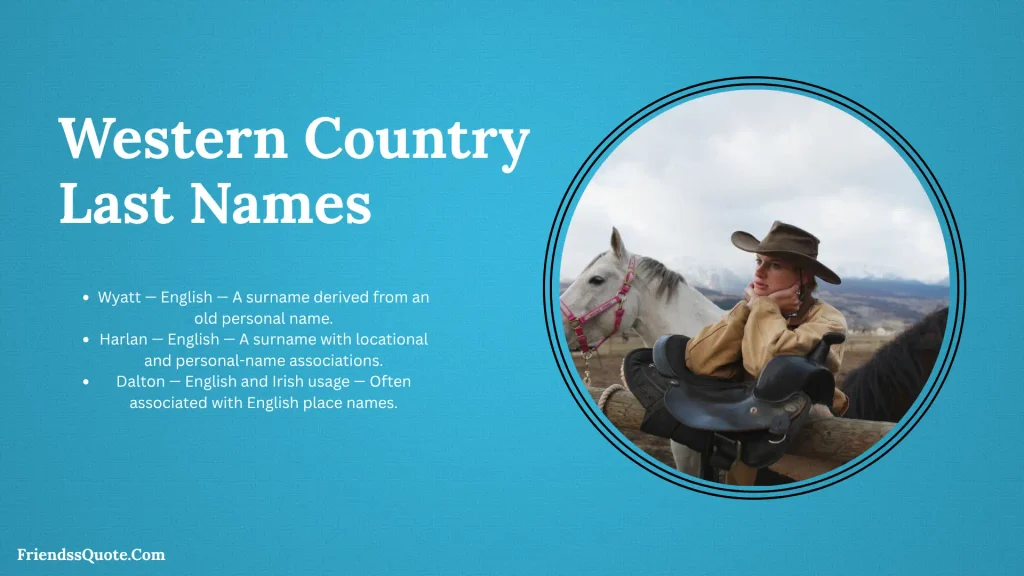
Western-style surnames often bring to mind ranches, open plains, frontier towns, horseback riding, and classic Western fiction. This is a cultural association, not a separate surname origin.
If you’re naming a character in a Western story or looking for a name with a rugged sound, these options may fit.
- Wyatt — English — A surname derived from an old personal name.
- Harlan — English — A surname with locational and personal-name associations.
- Dalton — English and Irish usage — Often associated with English place names.
- Boone — English and French-influenced history — A surname with several possible historical roots.
- Cody — Irish and English usage — A surname associated with Irish family-name traditions and other origins.
- West — English — A directional surname associated with a person or place to the west.
- Eastwood — English — A local surname associated with an eastern wood.
- Wilder — English and German usage — Has multiple possible origins, including descriptive and personal-name histories.
- Dillon — Irish and English usage — A surname with multiple historical roots.
- Clayton — English — A local surname derived from place names.
- Hickman — English — A surname with historical personal-name or descriptive origins.
- Crockett — Scottish and English usage — A historical surname with more than one possible etymology.
- Travis — English and French-influenced history — A surname historically associated with a crossing or toll crossing in some interpretations.
- Prescott — English — A local surname associated with a priest’s cottage or a place bearing that name.
- Colter — English and other possible origins — A surname with multiple historical interpretations.
For a classic Western feel: Wyatt, Boone, West, Dalton, and Crockett are especially recognizable choices. Their cultural associations should not be confused with proof of a family’s frontier history.
Common and Popular Country Last Names
Some surnames feel familiar because they are widespread in English-speaking communities or frequently appear in books, films, and everyday life. However, “common” and “popular” are not the same as “country.” A surname can be widespread in cities and rural areas alike.
Here are familiar surnames that can work for a country-inspired name list.
- Smith — English and Scottish usage — Occupational surname associated with metalworking.
- Johnson — English and Scottish usage — Patronymic meaning “son of John.”
- Williams — English and Welsh usage — Patronymic derived from William.
- Brown — English and Scottish usage — Often developed from a descriptive nickname.
- Jones — Welsh and English usage — Patronymic meaning “son of John.”
- Miller — English and other European usage — Occupational surname associated with milling.
- Davis — Welsh and English usage — Patronymic meaning “son of David.”
- Wilson — English and Scottish usage — Patronymic meaning “son of Will or William.”
- Taylor — English and French-influenced usage — Occupational surname associated with tailoring.
- Anderson — Scottish, Scandinavian, and other European usage — Patronymic meaning “son of Andrew.”
- Thomas — Welsh, English, and other European usage — Derived from the personal name Thomas.
- Thompson — English and Scottish usage — Patronymic meaning “son of Thomas.”
- White — English and Scottish usage — May derive from a descriptive nickname, although origins vary.
- Harris — English and Welsh usage — Patronymic associated with Harry or Henry.
- Martin — English and multiple European traditions — Derived from the personal name Martin.
These are established surnames rather than an official ranking of the most popular country names. For verified U.S. surname frequency, consult Census Bureau surname data rather than relying on a name’s familiarity.
American Country Last Names
American country-style surnames developed through a wide range of family histories. English and Scots-Irish names are prominent in many traditional rural settings, but American naming also reflects German, French, Spanish, African, Indigenous, and many other cultural influences.
The following names can work well for characters, family-history exploration, or an American countryside theme.
- Adams — English and Scottish usage — A patronymic derived from Adam.
- Armstrong — Scottish and English border-region history — A historical nickname-based surname.
- Bennett — English and French-influenced history — Derived from Benedict.
- Campbell — Scottish — Associated with a Gaelic nickname traditionally interpreted as “crooked mouth.”
- Collins — English and Irish usage — Has multiple possible origins, including patronymic forms.
- Duncan — Scottish and Irish usage — Derived from a Gaelic personal name.
- Ferguson — Scottish and Irish usage — Patronymic meaning “son of Fergus.”
- Graham — Scottish and English usage — A surname associated with historical place-name and family traditions.
- Hamilton — Scottish and English usage — A local surname associated with places in Britain.
- Jennings — English and Welsh usage — Derived from a medieval personal-name form.
- Kennedy — Irish and Scottish usage — A surname with Gaelic roots and multiple historical interpretations.
- Morgan — Welsh and other origins — Derived from a personal name used in Wales and elsewhere.
- Parker — English — Occupational surname associated with a park keeper.
- Reynolds — English and Irish usage — Derived from personal-name forms related to Reynold.
- Spencer — English — Historically associated with a steward or dispenser of provisions.
- Sullivan — Irish — An anglicized Irish surname with Gaelic roots.
- Turner — English — Occupational surname associated with turning materials.
- Warren — English and French-influenced history — May be associated with a place or an enclosed area for animals.
- Watson — English and Scottish usage — Patronymic meaning “son of Wat,” a medieval form of Walter.
- Young — English and Scottish usage — Often derived from a nickname distinguishing a younger person.
A surname’s presence in the United States does not mean it originated there. Many American surnames arrived through migration, while others developed through adaptation, translation, or changes in spelling over generations.
How to Choose a Country Last Name
The best country last name depends on how you plan to use it. A name that works for a historical novel might feel too formal for a modern character, while a short surname may be ideal for a username or a first-name combination.
Consider these factors before choosing:
- Sound: Say the full name aloud. Check how the surname flows with the first name.
- Meaning: Choose a surname whose documented meaning or historical association fits your goal.
- Setting: A story set in rural Texas may call for different naming research than a story set in medieval England or the Scottish Highlands.
- Time period: Some names or spellings may feel more appropriate for a particular historical era.
- Uniqueness: Decide whether you want a familiar surname or one that stands out.
- Cultural accuracy: If your character has a specific family background, research names associated with that background instead of choosing based only on appearance or sound.
How to research a surname’s true origin
If you want to investigate a family name rather than simply choose a name for its style, start with historical records.
- Record the surname’s earliest known spelling in your family.
- Identify the places where your relatives lived.
- Compare census records, birth and marriage records, church registers, immigration documents, and other relevant sources.
- Check reputable surname dictionaries and linguistic references.
- Treat proposed meanings cautiously when a surname has several possible origins.
Spelling changes can occur as families move between languages or countries. A surname may also have developed independently in more than one place. For that reason, a name’s meaning can suggest a research direction, but it cannot establish a family connection by itself.
Frequently Asked Questions
What makes a last name sound country?
Country-style last names often evoke rural landscapes, traditional occupations, ranching, farming, or Southern and Western American culture. Names such as Fields, Walker, Carter, Brooks, and Wyatt may fit this style, although their actual origins vary.
What are some old-fashioned country last names?
Some traditional options include Bennett, Clark, Fletcher, Harrison, Marshall, Palmer, Turner, Webster, and Chapman. These surnames have established histories, but their origins and earliest documented uses differ.
Are country last names usually English?
No. English surnames are common in many country-style name lists, but rural communities have always included people from different linguistic and cultural backgrounds. Scottish, Irish, German, French, and other surnames can also fit a country-inspired theme.
Can you use a surname as a first name?
Yes. Surnames such as Harper, Parker, Sawyer, Morgan, and Bailey are also used as given names. Consider the sound, spelling, meaning, and full-name combination before choosing one.
How can you find the original meaning of a family name?
Start with a reputable surname dictionary, then compare its explanation with historical records from the places where your family lived. Census records, church registers, immigration documents, and birth records may help establish your family’s particular history.
Do people with the same last name belong to the same family?
Not necessarily. The same surname can develop independently in different locations, and unrelated families can inherit identical surnames. Genealogical records are needed to establish a documented family connection.
Conclusion
Country last names offer plenty of choices, whether you prefer traditional family names, rustic landscape surnames, Southern inspired options, or distinctive Western style names. Choices such as Brooks, Carter, Fields, Wyatt, and Walker can give a character or name combination a familiar countryside feel, while names such as Arkwright, Kincaid, and Hollingsworth offer a more distinctive sound.
When choosing a surname, look beyond its style. Consider its meaning, spelling, cultural background, and suitability for your purpose. If you’re researching your own family, use historical records to verify its origins. A surname can provide a useful clue about the past, but its documented family history matters more than its modern associations.

Patrick Collins is a writer with a passion for meaningful words and timeless quotes that inspire everyday life. He enjoys exploring themes of motivation, relationships, success, and personal growth through simple, relatable writing. Patrick is also the fictional author of Echoes of Quiet Courage and Where Hope Finds Its Voice, two original book concepts created for his author profile. When he’s not writing, he enjoys reading classic literature, traveling, and collecting memorable quotes. His goal is to share words that encourage, uplift, and leave a lasting impression.
 Brianna Lewis