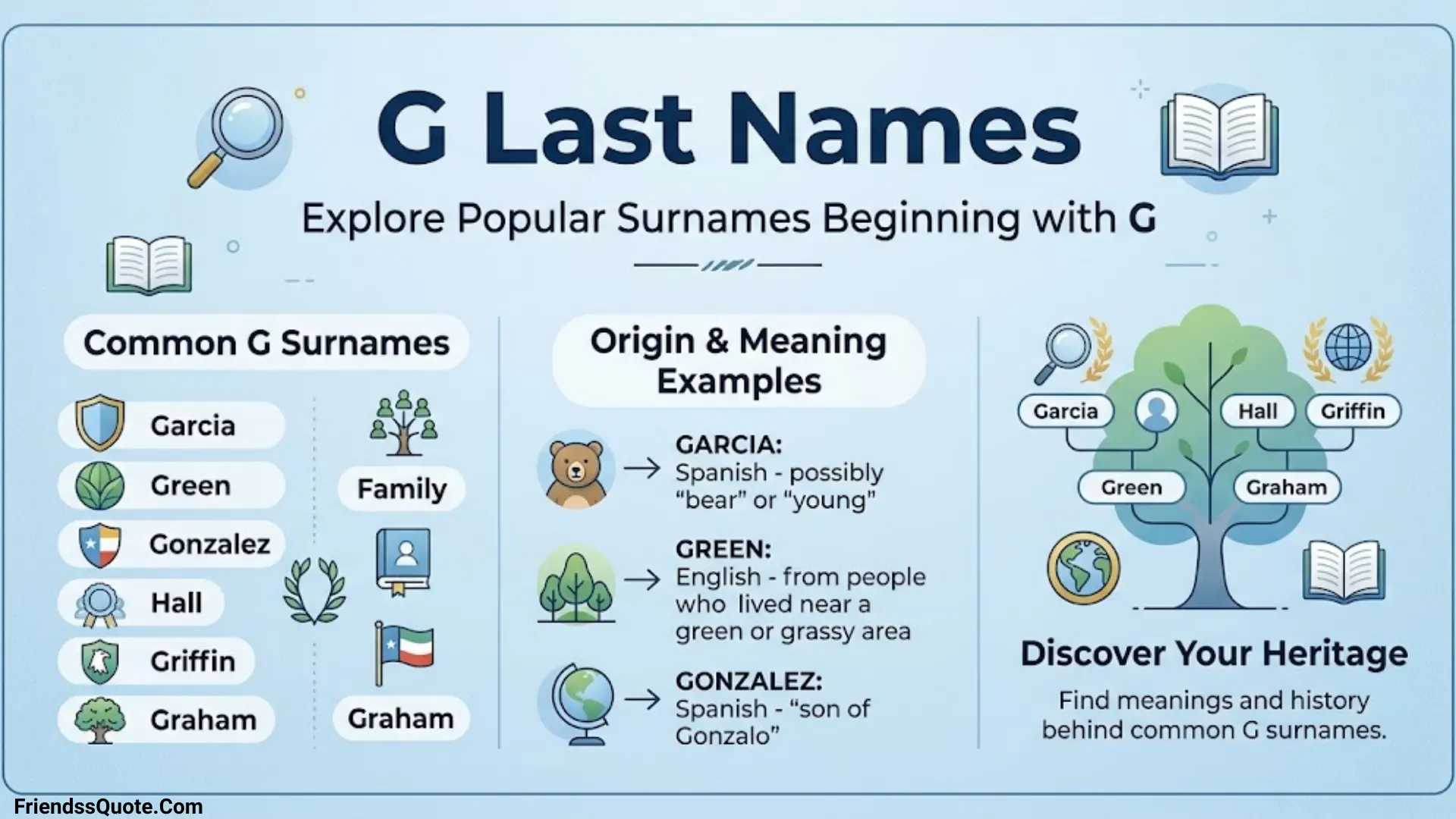
G last names are a great place to start if you are searching for unique surnames, popular family names, or interesting names with meaningful origins. Many surnames beginning with G come from different cultures and regions around the world. Whether you are researching your family history or simply exploring names, you can discover plenty of options to match your interests.
If you want a surname that sounds elegant, traditional, or distinctive, there are many G last names to explore. Some are connected to occupations, geographical locations, family traditions, or personal characteristics. Learning about their meanings and origins can help you understand the stories behind these names and find one that feels right for you.
In this guide, you will discover a collection of G last names, including popular, rare, unique, and meaningful surnames. Whether you need a name for a fictional character, want to learn more about your ancestry, or are simply curious about surnames, this list will help you explore different options and their fascinating backgrounds.
Common G Last Names
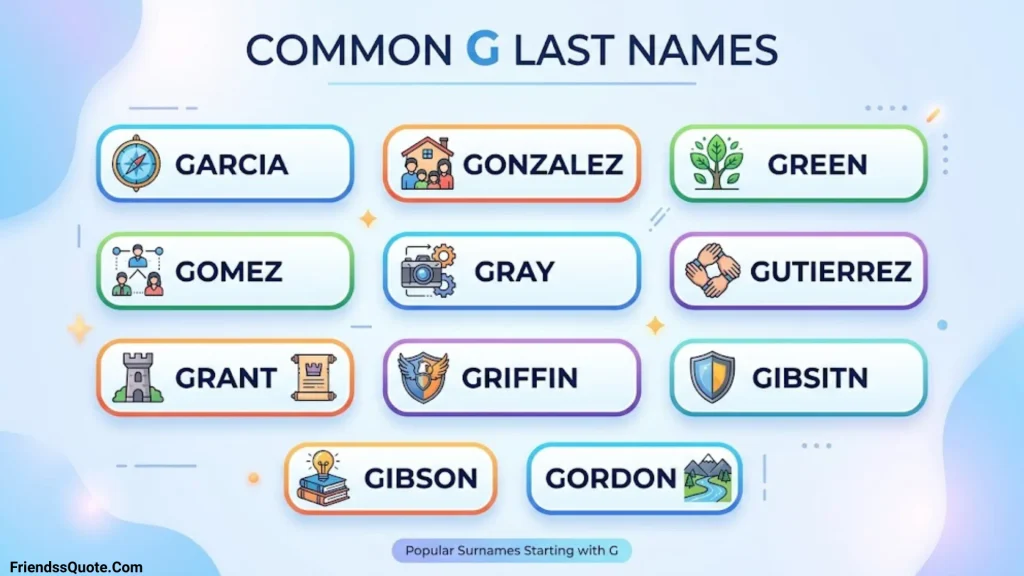
Many familiar American surnames begin with G. Some have English, Scottish, or Irish roots, while others are associated with Spanish-language naming traditions and other cultural backgrounds. The following names are useful starting points if you’re looking for recognizable G surnames.
- Garcia
- Gonzalez
- Green
- Gomez
- Gutierrez
- Gray
- Gonzales
- Graham
- Griffin
- Gibson
- Guzman
- Gordon
- Garza
- Grant
- Gardner
- George
- Guerrero
- Greene
- Gilbert
- Garrett
Garcia, Gonzalez, Green, and Gomez are particularly recognizable examples in the United States. For formal popularity rankings, consult the U.S. Census Bureau’s surname tables and confirm which census year a ranking represents.
Remember that commonness doesn’t establish a surname’s age, exact origin, or meaning. A name may also have several independent histories in different regions.
Unique Last Names That Start With G
If you want a surname that feels distinctive, consider its sound, spelling, length, and cultural background. These examples offer a variety of styles, from short names to longer family names. Their inclusion doesn’t mean each one is statistically rare.
- Goldwyn
- Goodenough
- Greenfield
- Granger
- Galloway
- Gable
- Gresham
- Glenwood
- Goodridge
- Glassford
- Goldsmith
- Greenwood
- Greystone
- Gillingham
- Gainsborough
Some of these names have occupational, locational, or descriptive associations. For instance, Goldsmith is associated with the craft of working with gold, while Greenwood is a place-related name. The precise history of an individual family’s surname may differ from its general linguistic background.
When choosing a distinctive surname for a fictional character, consider whether it fits the setting. A name associated with one language or region may feel out of place in a story set somewhere else unless the character’s background explains the connection.
G Last Names With Meaning
Surnames often developed from occupations, locations, personal names, nicknames, or physical features. Their meanings can change over time, and similar spellings don’t always share the same roots.
Here are several G surnames with commonly documented linguistic associations.
| Surname | Origin or language | Meaning or association |
| Gallagher | Irish | Anglicized form of Ó Gallchobhair, meaning descendant of Gallchobhar. |
| Galvin | Irish | From Ó Gealbháin; associated with the personal name Gealbhán. |
| Gorman | Irish | From Ó Gormáin, meaning descendant of Gormán. |
| Grady | Irish | From Ó Gráda or Ó Grádaigh, associated with the personal name Gráda. |
| Gerber | German | An occupational surname associated with a tanner. |
| Graf | German | Historically associated with a count or a person holding a count’s title. |
| Gallo | Italian | Can be associated with gallo, the Italian word for rooster; surname origins can vary. |
| Greco | Italian | Associated with the Italian word for Greek and historically used as an ethnic or descriptive name. |
| Ghosh | Bengali and other South Asian contexts | A surname with regional and historical associations; a single English translation is not reliable for every family. |
| Gupta | South Asian, especially associated with India | From Sanskrit gupta, commonly interpreted as protected or concealed. |
| Galang | Filipino usage | A documented Filipino surname, but a single origin or meaning shouldn’t be assigned without family-specific evidence. |
| Gardner | English | An occupational surname for a gardener or someone who tended gardens. |
The Irish surname references identify Gallagher, Galvin, Gorman, and Grady as names rooted in Irish-language personal names and patronymic traditions.
These descriptions refer to general surname etymology, not a proven family history. If you’re researching your own ancestors, historical documents may reveal a different regional origin, an older spelling, or a family-specific explanation.
G Last Names for Girls
Last names generally aren’t inherently male or female. However, some surnames may sound elegant, soft, bold, or modern, making them appealing for a female character, a pen name, or a fictional family.
Consider these options by style:
| Style | Surname ideas |
| Elegant | Grafton, Granville, Gwendell |
| Short and simple | Gale, Gray, Glenn |
| Classic | Graham, Griffith, Gregory |
| Nature-inspired | Greenleaf, Grove, Garland |
| Distinctive | Goldwyn, Greystone, Gable |
| Strong-sounding | Grant, Griffin, Garrison |
These are creative style suggestions, not classifications of gender. Some names may have different histories or associations depending on the language and region.
For a realistic character, choose a surname that fits the character’s family background or setting. For a fantasy character, you have more freedom to prioritize rhythm, tone, and memorability.
German G Last Names
German surnames often developed from occupations, personal characteristics, places, or inherited family names. Some have recognizable meanings in modern German, but their historical use may be more complicated.
Here are several German surnames beginning with G:
| Surname | General association |
| Gerber | Traditionally associated with a tanner. |
| Graf | Associated historically with a count or noble title. |
| Grimm | A German surname also known through the Brothers Grimm. |
| Gross (Groß) | Related to the German word for large or tall. |
| Gärtner | An occupational name associated with a gardener. |
| Günther | A surname derived from the Germanic personal name Günther. |
| Geiger | An occupational surname associated with a violin or fiddle player. |
| Glaser | Associated with glassmaking or glasswork. |
German spelling can vary when names are recorded in English-language documents. For example, Groß may appear as Gross when the character ß isn’t used.
A German-looking surname doesn’t necessarily prove that a family lived in Germany. Migration, border changes, and spelling adjustments can all affect a surname’s recorded history.
Spanish G Last Names
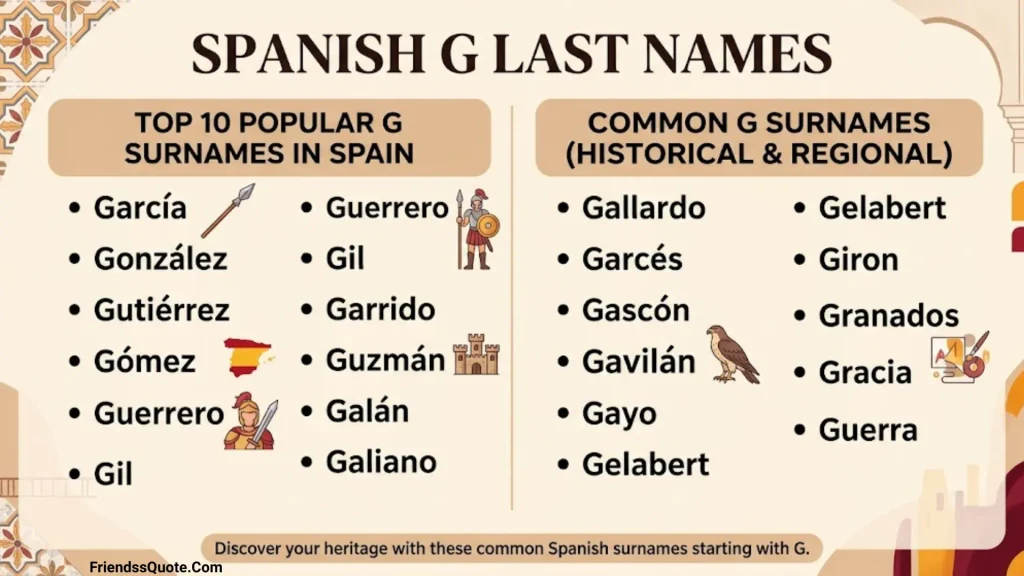
Spanish surnames beginning with G include patronymic names, place-related names, and family names with older linguistic roots. Many are also used throughout Latin America and other Spanish-speaking communities.
Examples include:
- Gallego: Associated with Galicia or a person from that region.
- Giménez: A Spanish surname derived from a personal name; also spelled Jiménez in a related form.
- Gutiérrez: A patronymic surname meaning descendant of Gutierre.
- Guerra: Related to the Spanish word for war; the history of a particular family name may vary.
- Garrido: A Spanish surname associated with an older descriptive word.
- Granados: A surname related to granado, meaning pomegranate tree in Spanish.
- Gálvez: A Spanish surname associated with a personal-name tradition.
- Guevara: A surname associated with a place-name tradition in the Basque region.
Spanish surname spellings may include accent marks, and related forms can differ by region. When searching genealogy records, try historical spelling variants if the original documents don’t use modern Spanish orthography.
Hispanic and Mexican G Last Names
Hispanic surnames are not limited to one country or a single cultural background. They can reflect Spanish, Indigenous, African, and other family histories, depending on the country and the individual family.
Mexican surnames beginning with G include several names commonly associated with Spanish-language surname traditions, alongside names with more complex regional histories.
Examples include:
| Surname | Context |
| Galindo | Found in Spanish-language surname traditions. |
| Gallardo | A surname used in Spain and Latin America. |
| Godoy | A Spanish surname also found in Latin American communities. |
| Granados | Found in Spanish-speaking regions. |
| Grijalva | A surname associated with Spanish-language naming traditions. |
| Galicia | A surname that may have geographic associations. |
| Gamboa | A surname found in Spanish-speaking communities, with possible regional variation. |
| Guevara | A surname with historical place-name associations. |
These names may occur in Mexico and other Hispanic communities, but they aren’t exclusive to Mexican families. The same surname can be present in different countries because of migration, colonial history, marriage, and independent family lines.
It’s also important not to treat a Spanish-language surname as proof of a person’s ethnicity or ancestry. Family records are more useful than a surname alone when tracing a particular lineage.
Asian G Last Names
Asia contains many distinct languages, writing systems, and surname traditions. A surname beginning with G in English may reflect a transliteration from a different script, so similar spellings don’t necessarily indicate the same origin.
The following examples represent different regions and naming systems.
| Surname | Region or language context | Important note |
| Gao | Chinese | A common Mandarin pinyin spelling; characters and family histories can differ. |
| Gu | Chinese and Korean romanization contexts | The spelling can represent different names in different languages. |
| Goto | Japanese | A Japanese surname whose precise origin depends on the family and written form. |
| Gupta | South Asian, especially India | A surname associated with Sanskrit-derived naming traditions. |
| Ghosh | Bengali and other South Asian contexts | A surname with regional and historical associations. |
| Ganguly | Bengali | A surname associated with Bengali naming traditions. |
| Gurung | Nepal and Himalayan communities | A surname or family name associated with Gurung communities. |
| Goh | Southeast Asian Chinese communities and other contexts | A romanized surname whose origins depend on language and family history. |
| Galang | Filipino | Used in the Philippines; a specific family’s etymology needs separate verification. |
Romanization means representing a name written in another script using the Latin alphabet. For example, a Chinese surname can have different spellings depending on the dialect or romanization system used.
For Korean surnames, the letter G can also appear in some romanized forms, but the common surname 김 is usually written Kim under standard modern romanization conventions. The specific Hangul and, where relevant, Hanja characters matter more than an English spelling alone.
Irish G Last Names
Irish surnames often preserve elements of the Irish language and older family naming traditions. Prefixes such as Ó historically indicate descent from a named ancestor, while Mac generally means son of.
Here are several Irish surnames beginning with G:
| Surname | Origin or meaning |
| Gallagher | From Ó Gallchobhair, meaning descendant of Gallchobhar. |
| Galvin | From Ó Gealbháin, associated with the personal name Gealbhán. |
| Gilmore | Can derive from Irish Gaelic Mac Giolla Mhuire, as well as a Scottish Gaelic form. |
| Gilroy | An anglicized form of an Irish Gaelic surname. |
| Gorman | From Ó Gormáin, meaning descendant of Gormán. |
| Gough | An anglicized surname with Irish Gaelic origins in some families. |
| Grady | From Ó Gráda or Ó Grádaigh. |
| Guinness | An Irish surname known through the Guinness family and brand. |
These names have documented connections to Irish naming traditions, although some also occur in Scotland or elsewhere.
Older Irish surnames may appear in multiple English spellings because names were adapted to English-language records over time. A family history may therefore require checking both modern spellings and historical variants.
Italian G Last Names
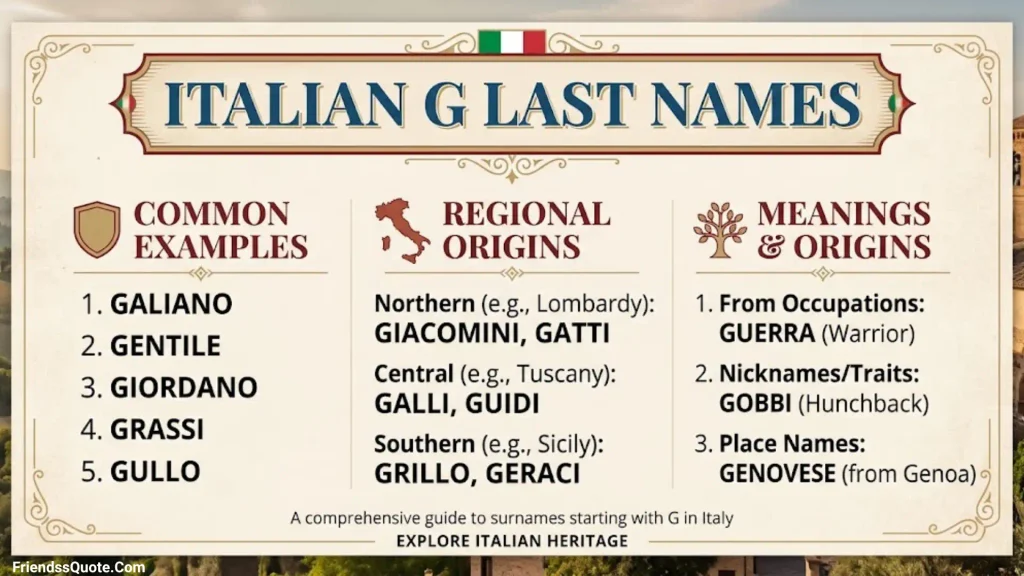
Italian surnames beginning with G include names linked to occupations, nicknames, personal names, and geographic or ethnic descriptions.
Examples include:
- Gallo: Associated with the Italian word for rooster, though individual family origins may differ.
- Greco: Related to the Italian word for Greek.
- Giordano: Derived from the personal name Giordano.
- Gentile: Related to the Italian word gentile, meaning gentle or kind, and historically used as a descriptive name.
- Grasso: Related to the Italian word for fat or stout, historically a possible nickname.
- Gatti: Related to gatto, the Italian word for cat, though surname histories can vary.
- Garofalo: An Italian surname associated with the word for carnation.
- Genovese: Often associated with Genoa or someone from that area.
- Giuliani: A surname derived from the personal name Giuliano.
- Graziani: A surname associated with the personal name Graziano.
A dictionary meaning doesn’t always explain why a particular family acquired its surname. For genealogy, regional records and older spellings can provide a more reliable explanation than a modern word translation alone.
Filipino G Last Names
Filipino surnames reflect the country’s many languages, communities, and historical influences. Some have Spanish spellings, while others come from Indigenous Philippine languages, Chinese-language naming traditions, or other sources.
Examples of Filipino surnames beginning with G include:
- Galang
- Gatchalian
- Gatdula
- Gozum
- Guinto
- Gamboa
- Garcia
- Gonzales
- Guevarra
- Go
These surnames are used in the Philippines, but they don’t all share one origin. Some are also found in Spanish-speaking countries or Chinese diaspora communities.
An important historical detail helps explain this variety: in 1849, Spanish colonial authorities issued a decree associated with the Catálogo alfabético de apellidos, an alphabetical catalog of surnames. The system influenced surname adoption and recordkeeping across the Philippines. The catalog included Spanish names and names from other sources, so a Spanish looking Filipino surname doesn’t automatically establish Spanish ancestry.
If you’re researching a Filipino family, look for church registers, civil records, local histories, and documents from the family’s home province. A surname’s presence in a historical catalog is useful evidence, but it doesn’t by itself prove the history of an individual family.
Actors With G Last Names
If you’re looking for famous surnames beginning with G, the entertainment industry offers plenty of recognizable examples. These public figures are useful references for people exploring surnames for characters, writing projects, or general interest.
| Actor or public figure | Last name |
| Ryan Gosling | Gosling |
| Whoopi Goldberg | Goldberg |
| Jennifer Garner | Garner |
| Maggie Gyllenhaal | Gyllenhaal |
| Danny Glover | Glover |
| John Goodman | Goodman |
| Greta Gerwig | Gerwig |
| Hugh Grant | Grant |
| Karen Gillan | Gillan |
| Ginnifer Goodwin | Goodwin |
| Kelsey Grammer | Grammer |
| Andrew Garfield | Garfield |
This is a selection of actors and entertainment figures, not a ranking. A famous person sharing a surname with your family doesn’t establish a genealogical connection.
How to Find the Origin of a G Surname
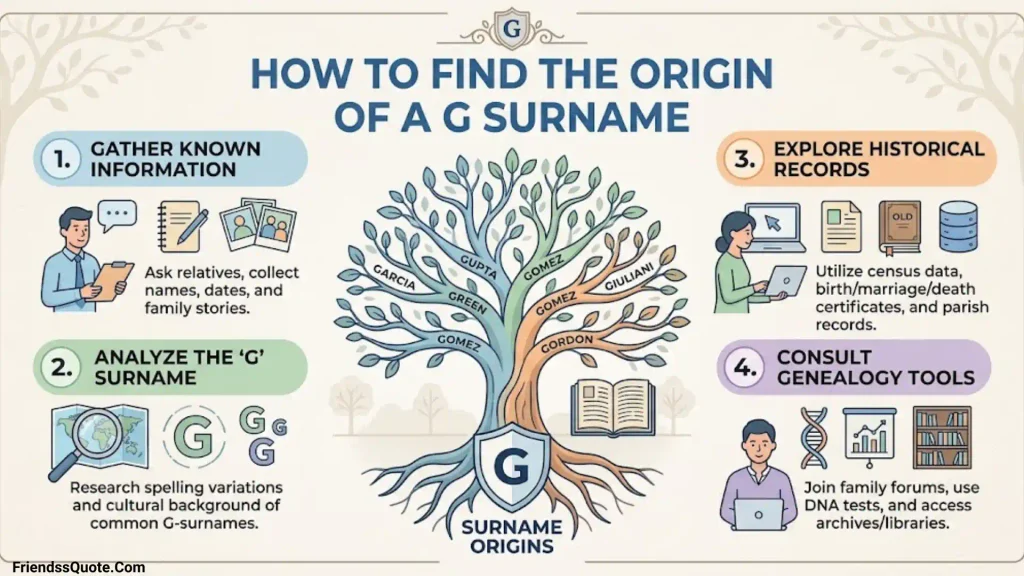
If you want to learn where your family name came from, start with records connected to your own relatives rather than relying only on general surname dictionaries.
- Ask relatives about older spellings. Family members may remember an alternate spelling, a place of origin, or a name change.
- Check birth, marriage, and death records. These documents can help establish family relationships and locations.
- Search historical census records. Census entries can show how a surname was recorded across generations.
- Look for immigration and naturalization documents. These may help identify a family’s country of origin or spelling changes.
- Compare multiple sources. A surname dictionary can suggest an etymology, but historical records can help establish whether it fits your family.
- Consider regional language differences. The same surname may have several unrelated origins or spellings.
The U.S. Census Bureau provides surname-frequency datasets that can help you explore how common a name is in the United States. However, frequency data doesn’t establish an individual’s ancestry or the meaning of a surname.
Frequently Asked Questions
What Are the Most Common Last Names That Start With G?
Recognizable examples include Garcia, Gonzalez, Green, Gomez, Gutierrez, Gray, Graham, Griffin, Gibson, and Gordon. For an official U.S. ranking, consult the latest Census Bureau surname tables and confirm the data year.
What Are Some Unique G Last Names?
Goldwyn, Gresham, Goodridge, Galloway, Gainsborough, and Glassford are distinctive options. Whether a surname is rare or unusual depends on the region and population being considered.
What Does the Letter G Mean in a Last Name?
The letter G has no universal meaning in surnames. A family name beginning with G may come from an occupation, place, personal name, nickname, or word in a particular language.
Are G Last Names Suitable for Girls?
Yes. Most surnames can be used regardless of gender, although naming customs vary across cultures. If you’re choosing a surname for a character, consider the sound, cultural background, and setting rather than assuming a name is inherently feminine.
Which G Surnames Have Irish Origins?
Gallagher, Galvin, Gilroy, Gorman, and Grady are examples with documented connections to Irish-language surname traditions. Some Irish surnames also have Scottish or other regional associations.
Are All Spanish-Looking Filipino Surnames Spanish in Origin?
No. Filipino surname history is shaped by several influences, including Spanish colonial administration, Indigenous naming traditions, and migration. The 1849 surname catalog contributed to the spread of many Spanish-looking surnames, but a surname alone doesn’t prove Spanish ancestry.
How Can I Find the Meaning of My G Last Name?
Start with a reputable surname dictionary, then compare its explanation with family records, historical spellings, and regional information. Treat the meaning as a possible linguistic origin until you have evidence connecting it to your own family.
Do People With the Same G Surname Belong to the Same Family?
Not necessarily. The same surname can develop independently in different places, and unrelated families may share a name. Establishing a family connection requires genealogical evidence, not just a matching surname.
Conclusion
G last names range from widely recognized surnames such as Garcia and Green to culturally specific names with Irish, German, Italian, Asian, and Filipino roots. Some have clear occupational or linguistic associations, while others have several possible origins.
If you’re choosing a surname for a character, focus on its sound and suitability. If you’re researching your family, compare surname meanings with historical records and regional evidence. That approach gives you a more accurate picture than relying on a name’s spelling alone.

Patrick Collins is a writer with a passion for meaningful words and timeless quotes that inspire everyday life. He enjoys exploring themes of motivation, relationships, success, and personal growth through simple, relatable writing. Patrick is also the fictional author of Echoes of Quiet Courage and Where Hope Finds Its Voice, two original book concepts created for his author profile. When he’s not writing, he enjoys reading classic literature, traveling, and collecting memorable quotes. His goal is to share words that encourage, uplift, and leave a lasting impression.
 Brianna Lewis