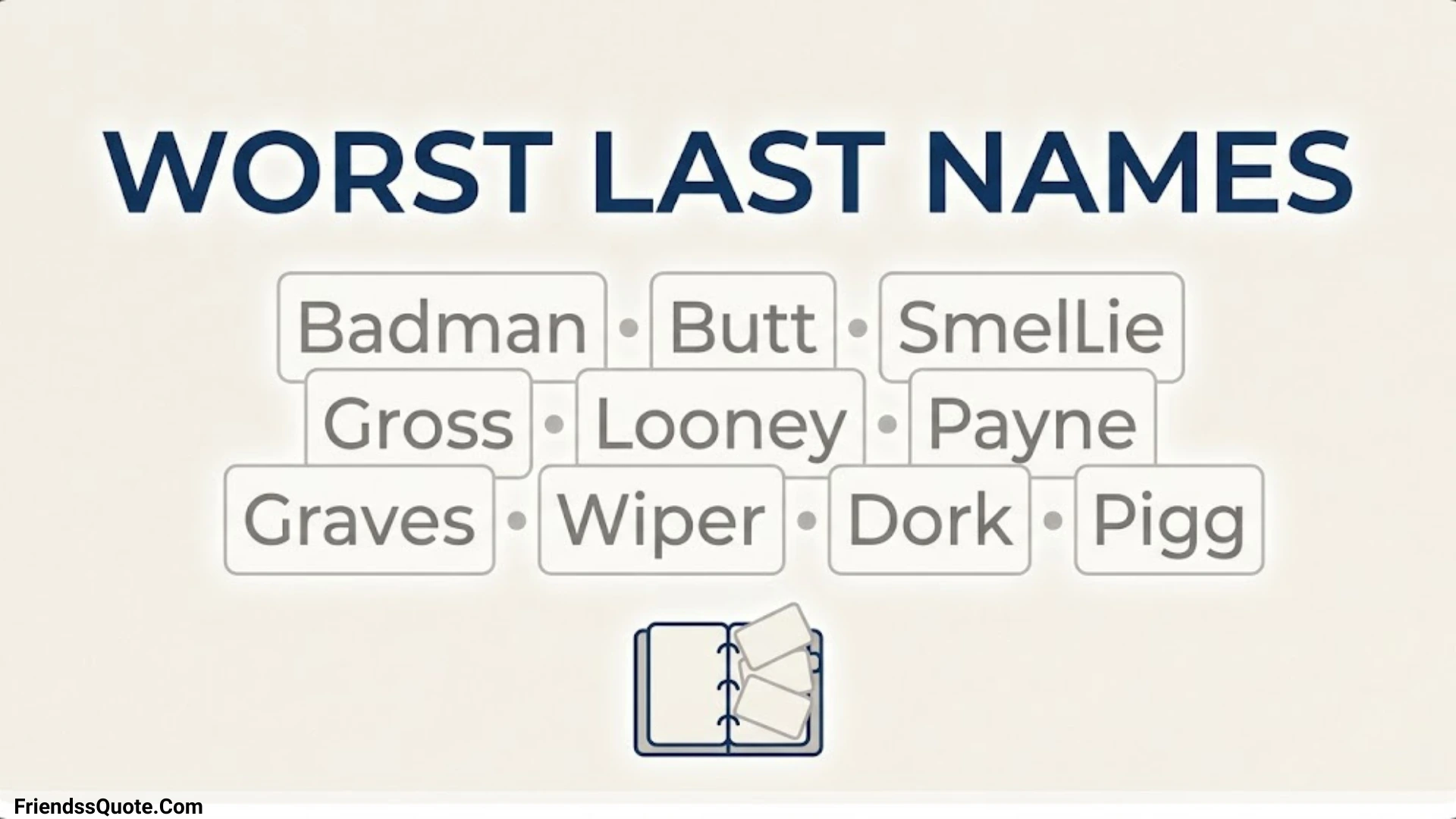
Last names can be funny, unusual, or sometimes a little embarrassing. Some surnames sound strange when spoken aloud, while others have meanings that make people laugh. If you are curious about the worst last names, you will find plenty of examples that are memorable, awkward, and surprisingly entertaining.
Many unusual surnames come from old occupations, family traditions, historical events, or words that have changed meaning over time. A name that sounds embarrassing today might have an interesting origin or a completely ordinary meaning in another language. That is why exploring these surnames can be both funny and educational.
In this guide, you will discover some of the worst last names, including funny, awkward, weird, and unusual surnames from different backgrounds. Whether you are looking for a laugh, researching name meanings, or simply curious about uncommon family names, this list will help you explore some truly unforgettable surnames.
Top 10 Worst Last Names
These ten surnames stand out because of their spelling, familiar English words, or unexpected sound. They’re examples of names that some English-speaking readers might find amusing, not an objective ranking of the worst family names.
- Glasscock — An English surname associated with Glascote, a place in Staffordshire. Its modern spelling can attract jokes because of how the word looks in English.
- Butts — An English-language surname that resembles a familiar informal word. Its appearance often makes it memorable.
- Shufflebottom — A distinctive English surname with an unusual combination of words and sounds.
- Sidebottom — A surname found in England that may sound humorous to people who recognize the word “bottom.”
- Hoare — A surname with historical English and Irish usage. Its spelling resembles a modern English insult, although that association doesn’t establish its original meaning.
- Balls — A surname that looks identical to a common English word with several meanings.
- Pigg — A surname whose spelling resembles the animal name “pig,” making it an easy target for wordplay.
- Smellie — A Scottish surname whose spelling resembles the English word “smelly.”
- Cockburn — A Scottish surname that is traditionally pronounced “CO-burn” by many bearers, rather than as its spelling might suggest to an unfamiliar reader.
- Weiner — A surname with German and Jewish usage, among other family histories, that resembles the English word “wiener.”
These names illustrate an important point: a funny spelling doesn’t necessarily mean a funny origin. Some surnames developed from places, occupations, personal names, nicknames, or older words whose meanings have changed over time.
Funny Last Names That Sound Awkward in English
Funny last names often become memorable because they resemble everyday words, create unexpected combinations, or have pronunciations that differ from their spelling.
Here are more examples worth knowing.
- Hogg — A surname that resembles an older English term for a pig.
- Bacon — An English surname associated with the familiar food word, although a surname’s history isn’t necessarily connected to the food itself.
- Peacock — An English surname that also names a colorful bird.
- Small — An English and Scottish surname that can be associated with a person’s stature or a nickname, depending on its family history.
- Long — A surname found in several language traditions, including English and Chinese. Its origin depends on the particular family.
- Hardman — An English surname that may be interpreted as a combination of familiar English words.
- Dicks — A surname that can derive from Dick, a traditional short form of Richard.
- Cox — An English surname that can have several historical origins, including forms related to a nickname or personal name.
- Crapp — A surname whose spelling resembles a vulgar English word, although the resemblance doesn’t establish a shared origin.
- Nutter — An English surname that also resembles an informal modern term for an eccentric person.
- Death — A real surname whose appearance can sound ominous in English.
- Slaughter — An English surname that resembles a word associated with killing, but its historical surname origin must be considered separately from its modern meaning.
- Hooker — An English surname that may have occupational or locational origins. Its modern slang association is not proof of the original meaning.
- Pope — An English surname associated historically with a religious title or nickname.
- King — A surname found in several cultures that can have origins in a title, nickname, or other naming tradition.
A surname can be amusing without being rare. Many familiar English words also became family names over generations. To understand a particular surname, look at its earliest known spelling, the language of the family’s region, and historical records rather than relying on a modern dictionary alone.
Worst Last Names for Girls
There aren’t separate universal lists of bad surnames for girls. In most English-speaking naming systems, the same inherited surname can be used by people of any gender. However, if you’re looking for unusual surnames for a fictional female character, these examples may fit a humorous or quirky story.
- Miss Butts — A fictional character name that may sound comical because of the surname’s familiar English association.
- Daisy Hogg — A fictional combination that pairs a cheerful first name with an animal-associated surname.
- Ruby Smellie — A fictional name that creates wordplay in English.
- Penny Nutter — A playful fictional name that sounds distinctive.
- Millie Shufflebottom — A whimsical combination suited to lighthearted fiction.
These are creative name combinations, not claims that the surnames belong exclusively to women or that real people with these names should be embarrassed.
If you’re choosing a surname for a character, consider the setting, the character’s personality, the intended humor, and whether the joke might unfairly target a real cultural group.
Worst Last Names for Boys
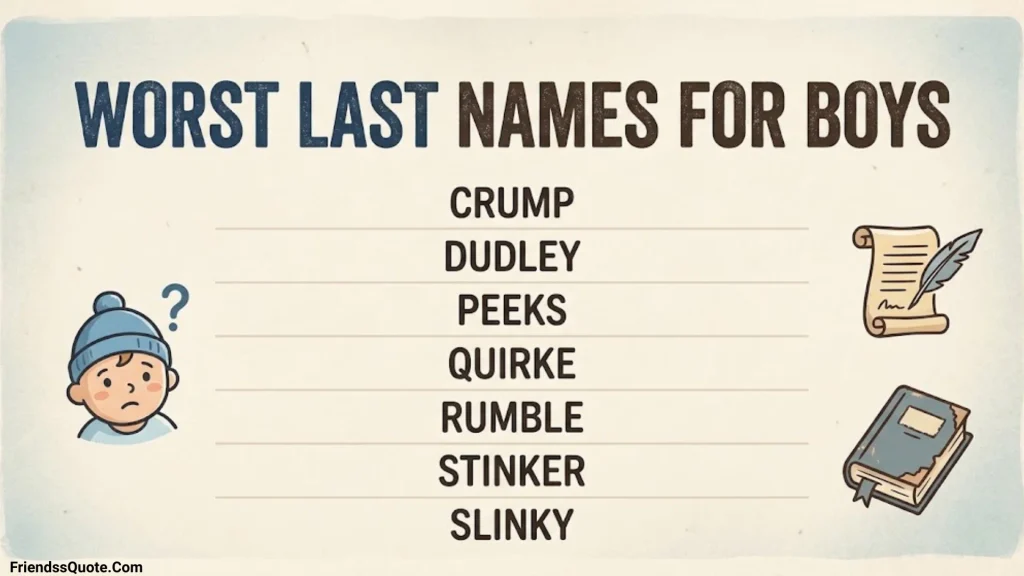
The same principle applies to boys. A surname doesn’t become worse because a boy carries it, but certain combinations can create memorable wordplay in fiction.
- Max Butts — A fictional name with an obvious comic sound.
- Jack Pigg — A short combination that may appeal to writers creating a humorous character.
- Benny Balls — A fictional name that relies on the familiar English word.
- Oliver Hardman — A strong-sounding combination that could suit a serious or comic character, depending on the story.
- Charlie Cox — A familiar-sounding name that demonstrates how an ordinary surname can work with many first names.
- Tom Nutter — A fictional combination that can suggest a quirky character in a comedy.
These examples are intended for character naming and wordplay. In real life, surnames are family identifiers, not reliable descriptions of a person’s personality, appearance, or behavior.
Why the Glasscock Surname Gets Attention on Reddit
Glasscock is frequently mentioned in conversations about unusual or funny-sounding surnames because its spelling creates an obvious association with modern English slang. However, the surname has a documented history that goes beyond that association.
Surname references trace the English form to Glascote near Tamworth in Staffordshire. The place name is connected to Old English elements commonly interpreted as “glass” and “hut” or “shelter,” possibly reflecting a location associated with glassmaking. The exact history of an individual family still requires genealogical evidence.
The spelling may encourage jokes online, but it doesn’t tell you anything about a person’s character or family history. Nor does a joke or a Reddit post establish the name’s true etymology.
If you encountered a specific Reddit discussion about Glasscock, check the original post before repeating its claims. Online comments may be entertaining, but they aren’t a substitute for reliable surname research.
The Jimmy Reference in Worst Last Names Discussions
The query “worst last names Reddit Jimmy” doesn’t identify a specific person, post, or discussion clearly enough to establish what readers are looking for. It could refer to a person named Jimmy, a joke about a surname, or a particular online conversation.
Rather than invent a viral story, it’s better to verify the exact Reddit post before attributing a joke or reputation to someone. If the intended reference concerns a real person, use the person’s name accurately and avoid presenting an unverified anecdote as fact.
For readers interested in unusual names, the more useful approach is to examine the surname itself: its spelling, language, historical origin, and the reason it sounds funny to a modern English speaker.
Worst Last Names in America
The United States has surnames from many languages and migration histories. As a result, a name that sounds odd in American English may have a completely ordinary meaning in another language.
These surnames are examples of names that may attract jokes or surprise in the United States.
- Butts — Resembles a familiar informal English word.
- Glasscock — Its spelling creates an unintended slang association for some English speakers.
- Shufflebottom — Has an unusual sound and combination of syllables.
- Sidebottom — May sound humorous because of the word “bottom.”
- Smellie — Resembles “smelly” in English.
- Pigg — Looks like a variation of “pig.”
- Nutter — Resembles a modern informal term for an eccentric person.
- Dicks — Resembles a plural form of a word with vulgar meanings in contemporary English.
- Hoare — Can be misread because of its resemblance to an English insult.
- Cockburn — May be pronounced incorrectly by readers unfamiliar with its traditional pronunciation.
These are examples, not a ranking based on American census data. Without a clearly defined survey or dataset, it wouldn’t be accurate to claim that Americans consider these the ten worst surnames in the country.
If you’re researching an American family name, census records, birth and marriage records, immigration documents, and historical newspapers can help establish where a particular family lived and how its surname changed.
Worst Sounding Last Names Around the World
There is no single list of the worst surnames in the world. Pronunciation, humor, and taboo words differ across languages, so a name that seems funny to an English speaker may be ordinary elsewhere.
Here are examples of surnames that can produce unexpected associations for English-speaking readers.
- Weiner — A surname with German and Jewish family histories that resembles an informal English word for a sausage.
- Pope — An English surname associated with a religious title.
- King — A surname found in English and other naming traditions, with origins that can vary by family.
- Long — Used in English-speaking countries and as a romanized form of Chinese surnames, including Lóng. These forms do not necessarily share the same origin.
- Bacon — An English surname whose spelling matches the familiar food word.
- Hogg — A surname that resembles a term for a pig.
- Cockburn — A Scottish surname whose traditional pronunciation can surprise people unfamiliar with it.
- Cox — A surname with several possible historical origins.
- Pigg — An English-language spelling that resembles an animal name.
- Death — A surname that can sound dramatic because it matches a familiar English word.
These examples shouldn’t be treated as a representative ranking of surnames worldwide. A truly global comparison would need to consider languages, scripts, local pronunciations, historical meanings, and the communities in which each surname is used.
A surname’s written form can also change when families move between countries. Transliteration, official records, and differences between writing systems may produce several spellings for names that share a historical source.
Unusual Last Names in Sports
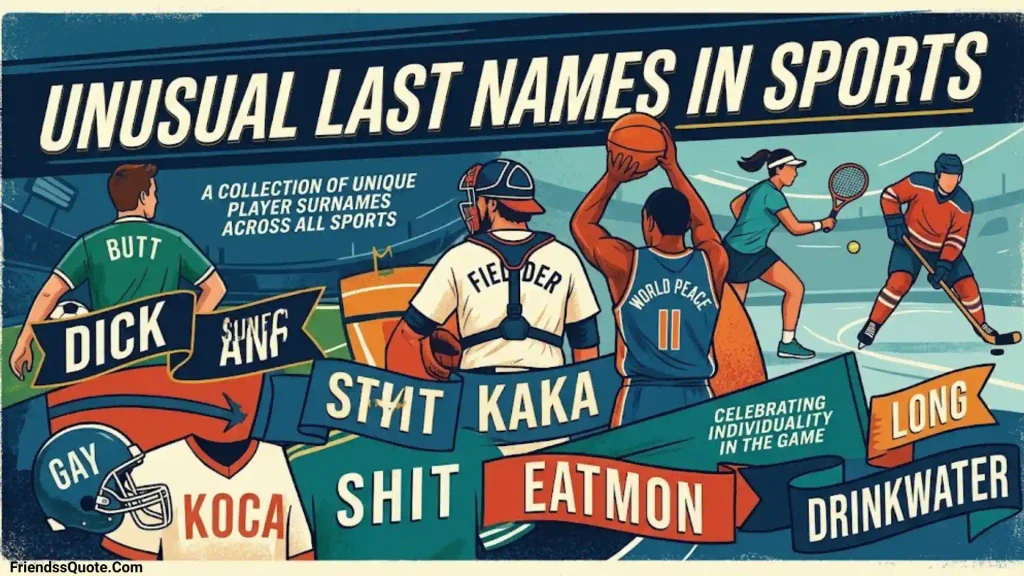
Sports rosters and historical records contain plenty of names that stand out to English-speaking audiences. A surname may attract attention because it resembles slang, has an unexpected spelling, or is simply unusual to the reader.
One documented example is Jack Glasscock, a 19th-century American professional baseball player. His surname is a real family name with historical records, not a name created as a joke. The surname also appears in references to other people, demonstrating why it shouldn’t automatically be treated as a nickname or punchline.
When creating a list of funny athlete names, verify the athlete’s full name, sport, team, and playing period. Don’t confuse a nickname with a legal surname or repeat a joke as though it were a documented biographical fact.
It’s also important to remember that a name’s appearance has no bearing on athletic ability. The goal of this section is to explore memorable surnames, not to ridicule players or suggest that a name makes someone less capable.
Unusual Last Names in History
Historical surnames can sound surprising today because language changes. Words that once described a location, occupation, personal characteristic, or relationship may now carry different meanings.
Here are several examples.
- Glasscock — Appears in historical records, including the name of American baseball player Jack Glasscock.
- Bacon — A long-established English surname that may be associated with familiar food terminology by modern readers.
- King — A surname that may have developed from a nickname or title in some family histories.
- Pope — A surname connected in some cases to a religious title or nickname.
- Long — A surname with multiple origins, including English-language and East Asian naming traditions.
- Small — A surname that may reflect an old nickname or descriptive term, depending on the family.
- Slaughter — A surname whose modern English appearance can seem harsh, although its historical origin must be investigated separately.
These examples don’t establish a definitive list of the worst surnames in history. To understand a surname historically, look for early records and specialist surname dictionaries. A modern word association is not enough to prove what the name originally meant.
Worst Sounding Last Names in the Philippines
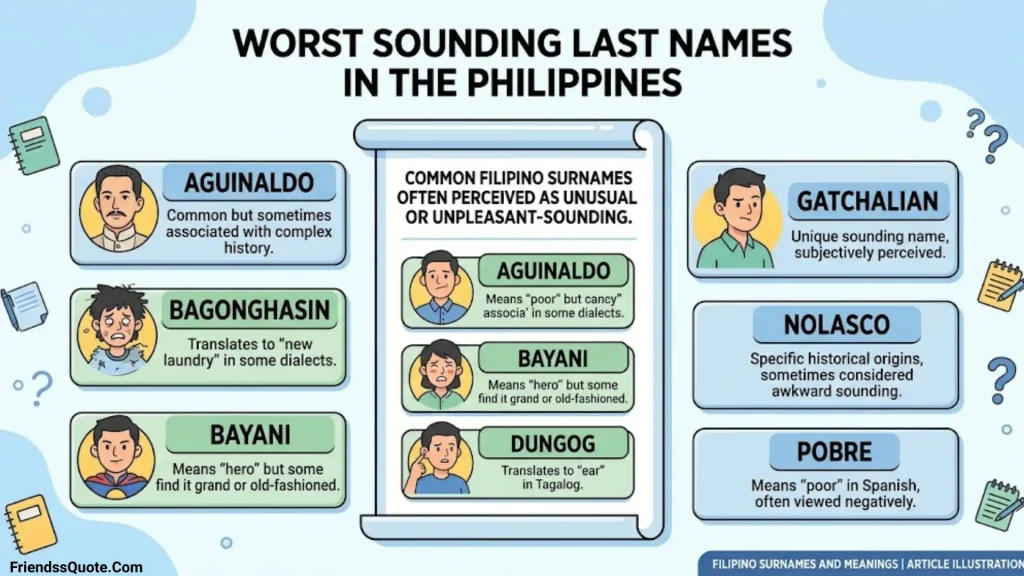
The Philippines has a diverse naming history shaped by Indigenous languages, Spanish colonial rule, and later social and legal developments. Many Filipino families have Spanish-derived surnames, but Filipino surnames also come from other linguistic and historical traditions.
The 1849 surname catalogue associated with Spanish colonial governor Narciso Clavería is an important part of this history. The catalogue was connected to efforts to standardize surname use across the Philippines. Later Philippine legal and administrative rules also shaped how family names are recorded.
Because Filipino surnames have varied origins, it would be misleading to label particular names as the country’s worst without clear evidence about how people in the relevant community perceive them. A surname that looks unfamiliar to an American reader may be perfectly ordinary to a Filipino family.
When exploring Filipino surnames, consider these points:
- Check the linguistic origin. A surname may have Spanish, Indigenous, Chinese, or another historical connection.
- Don’t assume every Spanish-looking surname indicates Spanish ancestry. Naming history and biological ancestry are different questions.
- Respect local pronunciation. The spelling alone may not tell an outsider how a name is pronounced.
- Use family records for genealogical claims. A surname by itself doesn’t prove that two people are related.
For more reliable research, consult historical surname catalogues, Philippine legal records, and family documents rather than relying on online lists of supposedly embarrassing names.
Frequently Asked Questions
What Is the Worst Last Name in the World?
There is no universally recognized worst last name. The answer depends on language, pronunciation, personal taste, and cultural context. Names such as Glasscock or Butts may attract jokes in English, but their appearance doesn’t establish their historical meaning or the character of the people who carry them.
What Are Some of the Funniest Last Names?
Examples that may sound funny in English include Butts, Glasscock, Shufflebottom, Sidebottom, Smellie, Pigg, and Nutter. Their humorous associations come mainly from modern English words and spelling rather than a shared origin.
Is Glasscock a Real Last Name?
Yes. Glasscock is a documented surname with English origins connected to Glascote in Staffordshire. Historical surname references explain it as a habitational name, meaning a surname associated with a place.
Are There Different Worst Last Names for children?
Not as a general rule. Most inherited surnames can be used by people of any gender. Separate lists are more useful for fictional character ideas than for classifying real people’s family names.
Why Do Some Last Names Sound Funny?
A surname may resemble a slang term, an everyday object, an animal, or a word with a different meaning in modern English. Pronunciation and spelling differences can also create unexpected associations.
Can a Surname Have More Than One Origin?
Yes. The same spelling can develop independently in different places or languages. Researchers need historical records, regional context, and family evidence to determine which origin applies to a particular person.
Do Unusual Last Names Reveal Someone’s Ancestry?
No. A surname can offer a clue for genealogical research, but it cannot prove a person’s ethnicity, nationality, or family relationship by itself. Family documents and historical records provide stronger evidence.
Conclusion
The worst last names are a matter of personal opinion, language, and context. Names such as Glasscock, Butts, Shuffle bottom, and Smellie may sound funny to some English speakers, but each surname belongs to a real naming tradition or family history.
If you’re researching an unusual surname, look beyond its modern sound. Its spelling, historical usage, language, and regional background may tell a more interesting story than an online joke ever could.

Brianna Lewis is a writer who believes the right words can inspire, comfort, and motivate people every day. She enjoys creating meaningful quotes, thoughtful messages, and uplifting content that readers can relate to. Brianna is also the fictional author of Echoes of Gentle Hearts and A Thousand Quiet Inspirations, two original works created for her author profile. When she’s not writing, she loves reading, journaling, and finding beauty in everyday moments. Her goal is to share words that leave a lasting, positive impression.
 Patrick Collins