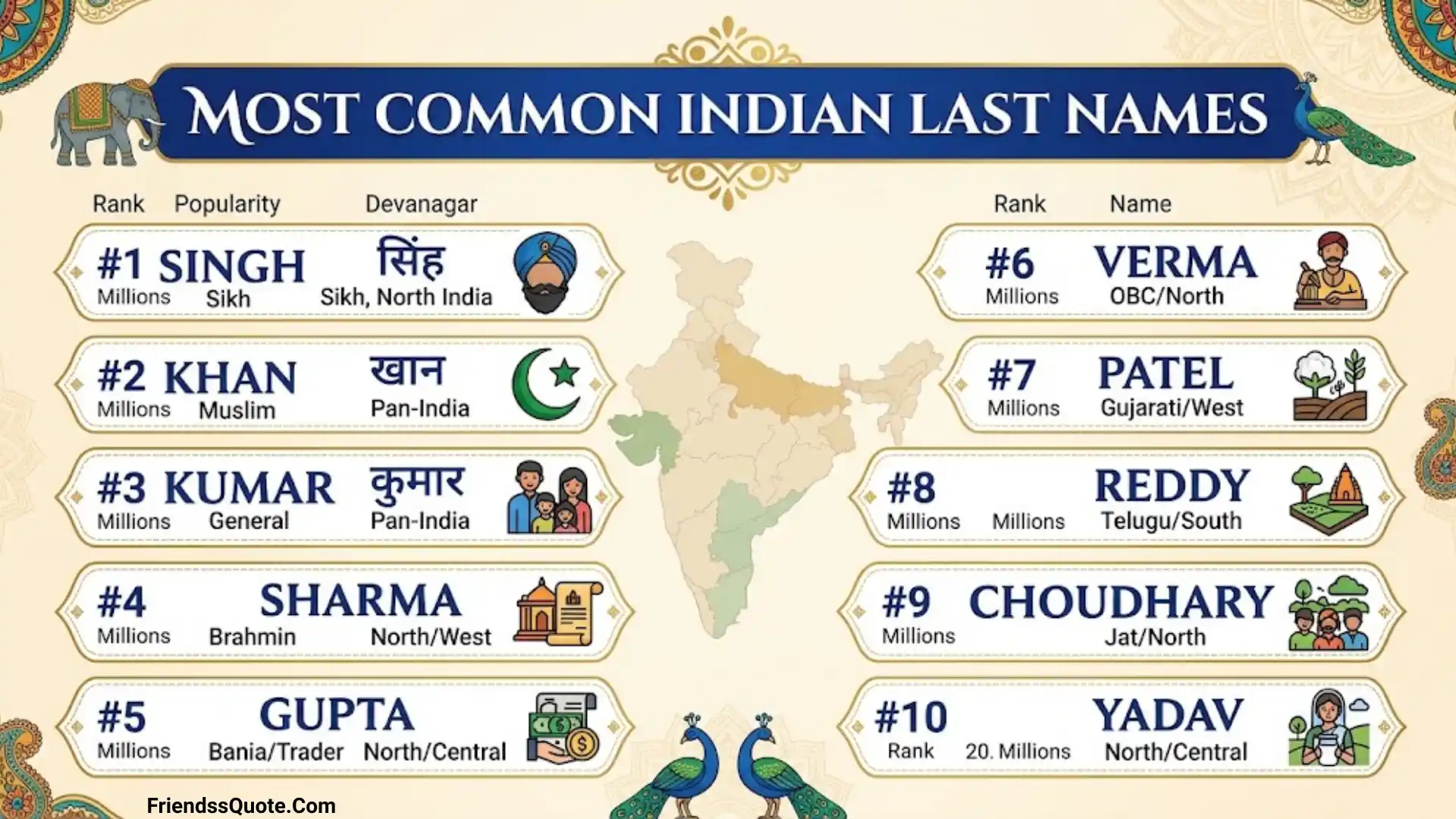
Indian last names reflect a wide range of languages, regional traditions, religious communities, occupations, and family histories. Some are found across much of India, while others are closely associated with particular states or linguistic groups. Names such as Singh, Kumar, Sharma, Patel, Gupta, and Das are familiar examples, but no single list captures the country’s full diversity.
If you’re researching family history, choosing a character name, or exploring Indian naming traditions, understanding a surname’s background can be just as useful as knowing how common it is. This guide covers popular Indian last names, their meanings, Hindu-associated surnames, names used by women, historical status associations, and Indian surnames found in the United States.
One important note: India’s surname-frequency figures depend on the database and methodology used. The rankings below use Forebears’ published India surname data as a reference, not as an official government census ranking. A surname may also serve as a given name, title, or other name element in some communities.
Top 10 Most Common Indian Last Names
Forebears’ published India surname database lists the following names among its ten most frequent entries. The figures reflect its reported estimates and should not be treated as a definitive, current government ranking. Some entries, including Devi, Kumar, Ram, and Kumari, can also function as given names or honorifics in different contexts.
- Devi — A Sanskrit-derived word associated with a goddess or divine feminine power. It also appears as a given name and traditional name element.
- Singh — Derived from Sanskrit siṃha, meaning “lion.” It is widely associated with Sikh communities and is also used by many Hindu communities.
- Kumar — A Sanskrit-derived term meaning “boy,” “youth,” or “prince,” depending on context. It is used as both a given name and a name element.
- Das — Commonly associated with the Sanskrit word for “servant” or “devotee.” Its history and religious associations vary across communities.
- Kaur — A name element traditionally used by Sikh women. It is commonly interpreted as “princess,” although its historical and cultural context is more complex than a simple translation.
- Ram — Derived from the name Rama, a major figure in Hindu tradition. It can appear as a given name or as part of a longer name.
- Yadav — Associated with the Yadava lineage in Hindu tradition and used as a surname by many communities, particularly in northern India.
- Kumari — A Sanskrit-derived term meaning “girl,” “maiden,” or “young woman.” It can be a surname, title, or given-name element.
- Lal — A name element with several regional uses. It is often associated with meanings such as “beloved” or “dear,” but its interpretation depends on the language and naming context.
- Bai — A traditional name element or honorific used in several Indian languages and communities. It does not have one universal surname meaning.
These examples illustrate why surname rankings need careful interpretation. A name’s frequency does not necessarily tell you whether it is exclusively a family name, what religion its bearers follow, or where every family using it originated.
Most Common Indian Last Names With Meaning

Indian surnames may describe occupations, places, lineages, personal characteristics, religious relationships, or historical roles. Some have more than one origin, and modern usage does not always preserve an older meaning.
Here are familiar Indian surnames and the most useful context for understanding them.
- Sharma — Sanskrit-associated — Traditionally associated with well-being, comfort, or joy. It is widely used among Hindu communities and has strong historical associations with Brahmin naming traditions in some regions.
- Gupta — Sanskrit — Commonly linked to the idea of being protected or concealed. It is a widespread surname with a long history in northern India.
- Patel — Gujarati and western Indian usage — Historically associated with village leadership, landholding, or revenue administration in parts of western India. It is especially well known among Gujarati communities.
- Verma — Multiple regional traditions — A spelling variant of Varma or Varman in some naming traditions. The Sanskrit-derived element varman is associated with protection or armor.
- Agarwal — Northern India — Associated with the Agarwal trading community. Traditional accounts connect the community’s name with the legendary King Agrasen, though particular family histories require separate evidence.
- Reddy — Telugu-speaking regions — A prominent surname and community name in Andhra Pradesh and Telangana. Its historical associations include local leadership and landholding.
- Iyer — Tamil-speaking communities — A surname associated with Tamil Brahmin communities. Its cultural and religious context is more informative than a single literal translation.
- Nair — Kerala — A surname associated with a historically significant community in Kerala. Its historical social roles and family customs have varied over time.
- Nair — Regional note — The same surname may appear in different family histories, so a name alone cannot establish a particular family’s social background.
- Nair should be counted only once in a surname list; its regional explanation does not make it a separate surname.
Additional examples include the following:
| Surname | Common association or meaning | Important context |
| Chatterjee | Anglicized form associated with Bengali Chattopadhyay | Bengali language and regional history matter. |
| Mukherjee | Anglicized form associated with Bengali Mukhopadhyay | It is not exclusive to one family lineage. |
| Banerjee | Anglicized form associated with Bengali Bandyopadhyay | Spelling reflects historical transliteration. |
| Ghosh | A surname found widely in Bengal and neighboring regions | Its origins and community associations vary. |
| Bose | Commonly associated with Bengali Basu | Different transliterations can represent related forms. |
| Chowdhury | A title-derived surname used in multiple South Asian regions | Its history varies by language and locality. |
| Mukherjee | Bengali surname form | This is the same surname as above, not a separate entry. |
| Jain | Associated with Jain religious identity in many cases | It is not exclusively a Hindu surname. |
| Mehta | Often associated with an administrative, accounting, or professional title | The exact history differs across regions and communities. |
| Desai | Historically associated with an administrative or revenue-related title in western India | It is also a modern inherited surname. |
| Kulkarni | Traditionally associated with a village record-keeping role in parts of western India | Occupational origins do not define modern bearers. |
| Joshi | Traditionally associated with learned or priestly roles in several regions | The surname has multiple regional histories. |
| Pandey | Associated in some traditions with learning or priestly roles | It is not proof of an individual’s occupation or beliefs. |
| Mishra | Commonly associated with Sanskrit and learned traditions | Its usage spans multiple communities and regions. |
| Tiwari | Associated with northern Indian naming traditions | Its specific etymology and family history can vary. |
| Dubey | Common in northern India | Historical interpretations should be checked against regional evidence. |
| Tripathi | Traditionally associated with learned or priestly traditions | Modern bearers may have varied occupations and backgrounds. |
| Saxena | A surname associated with particular northern Indian communities | A single universal literal translation is not sufficient. |
| Kapoor | Common among Punjabi and other North Indian families | It has regional and community histories. |
| Malhotra | Commonly associated with Punjabi naming traditions | The precise origin of a particular family requires genealogical evidence. |
These explanations are broad introductions rather than definitive etymologies for every family. For genealogy, compare the surname with the family’s original language, place of origin, older spellings, and historical records.
Top 100 Hindu Surnames

Hindu communities use a wide variety of surnames, and many surnames also appear among Sikhs, Jains, Muslims, Christians, and other communities. Some are regional, while others reflect occupations, titles, lineages, or older social structures.
The following is a broad list of 100 surnames used among Hindu communities in different parts of India. It is not a ranking of the 100 most frequent Hindu surnames, and it does not mean every person with one of these names is Hindu.
- Sharma
- Verma
- Gupta
- Agarwal
- Bansal
- Mittal
- Goel
- Singhal
- Garg
- Goyal
- Jain
- Mehta
- Shah
- Patel
- Desai
- Joshi
- Trivedi
- Dave
- Bhatt
- Pandya
- Thakkar
- Modi
- Kulkarni
- Deshmukh
- Patil
- Jadhav
- Pawar
- Chavan
- Shinde
- More
- Reddy
- Rao
- Naidu
- Chowdary
- Varma
- Iyer
- Iyengar
- Nair
- Menon
- Pillai
- Kurup
- Panicker
- Nambiar
- Shetty
- Hegde
- Gowda
- Bhat
- Kamath
- Acharya
- Poojary
- Mukherjee
- Banerjee
- Chatterjee
- Ghosh
- Bose
- Basu
- Dutta
- Datta
- Das
- Roy
- Sen
- Saha
- Pal
- Biswas
- Sarkar
- Mondal
- Majumdar
- Bhattacharya
- Chakraborty
- Ganguly
- Lahiri
- Mitra
- De
- Bandyopadhyay
- Mukhopadhyay
- Tiwari
- Mishra
- Pandey
- Dubey
- Tripathi
- Shukla
- Pathak
- Dwivedi
- Upadhyay
- Chaturvedi
- Srivastava
- Saxena
- Mathur
- Sinha
- Tyagi
- Tomar
- Chauhan
- Rathore
- Sisodia
- Solanki
- Parmar
- Bhardwaj
- Thakur
- Yadav
- Singh
How to interpret this list
The list includes surnames associated with communities and naming traditions in northern, southern, eastern, western, and central India. Some have several spellings, and some are shared across different religious or regional groups.
A surname may have historical associations with a particular community, occupation, or social position. Those associations should not be treated as universal rules for modern families. If you’re researching a particular surname, look for evidence tied to a specific location, language, and family rather than relying on a general list.
Most Common Indian Last Names for Girls
Indian surnames generally are not divided into separate male and female categories in the same way that some given names are. However, naming conventions differ among communities, and some women use particular surname forms, titles, or name elements.
If you’re looking for a surname for a female character, a family-history project, or a name combination, these are useful examples:
- Kaur — Traditionally used by Sikh women as a name element. It is one of the clearest examples of a gender-associated naming convention in this context.
- Devi — Used as a given name, title, and name element by women in several Indian communities. Its use as a family name varies.
- Kumari — Often associated with the meanings “girl,” “maiden,” or “young woman.” It may appear in a full name without functioning as a hereditary surname in every case.
- Sharma — A surname used by human beings in many families. It is not inherently a male surname.
- Gupta — Used by people of different genders and across generations.
- Patel — A widely recognized surname used by human beings.
- Reddy — Common in Telugu-speaking regions and used by people of different genders.
- Iyer — Associated with Tamil Brahmin naming traditions and used by women as well as men.
- Nair — Used by human beings in Kerala and among families with roots there.
- Mehta — A surname or title derived family name found in several regional traditions.
- Agarwal — Used by human beings in families associated with Agarwal communities.
- Shah — Found among families across western India and the wider South Asian diaspora.
- Joshi — A surname used across multiple Indian regions and communities.
- Kapoor — A familiar surname in Punjabi and North Indian naming traditions.
- Chatterjee — A recognizable Bengali surname used by human beings.
Do Indian women change their surnames after marriage?
There is no single rule followed by every Indian family. Some women adopt a spouse’s surname, some retain their birth surname, and others use different combinations or naming practices. The choice can depend on family preference, personal identity, legal documents, and regional or cultural traditions.
For a realistic character name, choose a surname that fits the character’s family background and setting rather than selecting one based only on gender.
Indian Surnames Associated With Royalty, Status, and Wealth
Some Indian surnames have historical connections with royal houses, landholding families, administrators, merchants, or influential communities. However, no surname reliably proves that a person is rich, belongs to royalty, or has aristocratic ancestry.
The following names may be useful when researching historical or social associations.
- Rathore — Associated with a Rajput clan and historically prominent royal houses, particularly in Rajasthan. A shared surname does not establish descent from a royal family.
- Sisodia — Associated with a Rajput lineage historically connected with Mewar. Its historical significance should not be confused with the present-day wealth of individual families.
- Chauhan — Associated with a Rajput clan and several historical ruling lineages. The name is also used beyond royal families.
- Solanki — Associated with historical dynasties and communities in western India. The surname alone cannot establish a person’s lineage.
- Parmar — Connected with historical ruling lineages and communities in parts of western and central India.
- Scindia — Associated with the former ruling house of Gwalior. It is a more specific historical association than a general claim about wealth.
- Gaekwad — Associated with the former ruling dynasty of Baroda.
- Jadeja — Associated with Rajput lineages and historical ruling families in Gujarat and neighboring areas.
- Patel — Historically connected with village leadership, land administration, and other local roles in some regions. Today, it is used by families from varied economic backgrounds.
- Agarwal — Associated with a trading community with a long commercial history. It does not indicate that every bearer is wealthy.
- Shah — Found among several communities, including merchant and trading families in western India. The surname has multiple regional uses.
- Mehta — Historically used as a title or surname in administrative, commercial, and professional contexts in several regions.
What makes a surname sound wealthy or prestigious?
In fiction and naming research, a surname may evoke wealth because of its association with a documented royal house, historical dynasty, or prominent public family. That is different from proving that the surname’s bearers generally have high incomes.
If you’re researching your own ancestry, use family documents, regional histories, land records, and genealogical sources to investigate a claimed connection. A surname by itself is not sufficient evidence.
Most Common Indian Last Names in the US

Indian-origin surnames are found throughout the United States, reflecting migration from different parts of India and the growth of Indian American communities. Names such as Patel, Singh, Shah, Gupta, Kumar, Reddy, and Sharma are familiar examples, although their relative frequency among Indian Americans should not be inferred from an India-wide ranking.
The U.S. Census Bureau released its 2020 surname data in April 2026. The published datasets include surname counts and tables organized by race and Hispanic origin, making them useful for examining name frequency in the United States. They do not provide a simple, definitive ranking of surnames among people of Indian ancestry alone.
Here are examples of Indian-origin surnames commonly encountered in the United States:
- Patel — A familiar surname among Indian Americans, particularly families with Gujarati roots.
- Singh — Used by many Sikh Americans and also by people from other Indian naming traditions.
- Shah — Common among some Gujarati and other South Asian American families.
- Gupta — Found among Indian-origin families with varied regional backgrounds.
- Sharma — A widely recognized surname among Indian Americans.
- Kumar — Used as a given name and surname or name element in different families.
- Reddy — Associated with Telugu-speaking communities, including families from Andhra Pradesh and Telangana.
- Rao — A surname or title-derived name used in several parts of India.
- Iyer — Associated with Tamil Brahmin communities.
- Nair — Associated with Kerala and families with roots in the region.
- Mehta — Found among families with different regional and community backgrounds.
- Agarwal — Associated with the Agarwal community and families with roots in northern India.
- Desai — Associated with several western Indian naming traditions.
- Joshi — Used across multiple regions and communities.
- Chowdhury — Found in different South Asian regions, including Bengal.
These examples are not presented as a verified top-15 ranking of Indian Americans. Establishing that ranking would require a defined population and analysis of appropriate surname data.
How to research Indian surnames in America
For a more precise comparison, use the Census Bureau’s surname tables and check the demographic categories and methodology accompanying the data. The bureau reports surname frequency and demographic characteristics, but a surname does not independently establish someone’s ancestry or national origin.
For family-history research, immigration records, naturalization documents, birth and marriage records, and older family documents may help explain why a surname appears in a particular American community.
How Indian Surnames Differ by Region and Tradition

India has many languages and naming customs. The same surname may have different origins in different regions, while families from the same region may follow different naming conventions.
Northern India: Sharma, Gupta, Verma, Agarwal, Tiwari, Mishra, and Srivastava are examples of surnames found among communities in northern parts of the country. Their regional and community associations vary.
Western India: Patel, Desai, Shah, Mehta, Kulkarni, and Deshmukh are associated with different naming traditions in Gujarat, Maharashtra, and neighboring regions.
Southern India: Reddy, Rao, Naidu, Iyer, Iyengar, Nair, Menon, and Shetty illustrate the diversity of surnames and other name elements used in southern India. In some communities, a person’s full name may incorporate a place name, a father’s name, or another element rather than following a simple first-name-plus-surname pattern.
Eastern India: Ghosh, Bose, Das, Roy, Sen, Banerjee, Mukherjee, and Chatterjee are examples of surnames found in Bengal and surrounding areas. Transliteration from regional scripts can produce different English spellings.
Sikh naming traditions: Singh and Kaur have important cultural and religious significance. Singh is widely used by Sikh men, while Kaur is traditionally used by Sikh women. Neither name should be used alone to make assumptions about an individual’s identity or family history.
Can an Indian surname tell you someone’s caste or religion?
Sometimes a surname has a strong historical association with a particular community, but it cannot reliably establish an individual’s caste, religion, or ancestry on its own. Surnames can be shared across communities, adopted through marriage, altered in official records, or used differently in different regions.
For family-history research, combine surname evidence with the family’s place of origin, original-language spelling, historical records, and reliable accounts of naming practices.
Frequently Asked Questions
What are the most common Indian last names?
Names such as Devi, Singh, Kumar, Das, Kaur, Ram, Yadav, Kumari, Lal, and Bai appear near the top of Forebears’ published India surname list. The exact ranking depends on the database and its methods, and some of these names also function as given names or other name elements.
What is the most common Hindu surname?
There is no single definitive answer that applies to all Hindu communities in India. Sharma, Gupta, Verma, Singh, and many regional surnames are familiar examples, but their frequency differs by region and community. A surname-frequency database should not automatically be treated as a ranking of Hindu surnames.
What does Singh mean in an Indian surname?
Singh comes from a Sanskrit word meaning “lion.” It has a major role in Sikh naming traditions and is also used by many Hindu communities. Its presence does not, by itself, establish a person’s religion, caste, or ancestry.
Do Indian women have different last names from men?
Not necessarily. Many Indian surnames are used by people of different genders. Some naming traditions use gender-associated name elements, such as Kaur in Sikh women’s names, while practices involving marriage and surname changes vary among families.
Can an Indian surname identify someone’s caste or religion?
A surname may be historically associated with a particular community, but it is not reliable proof of an individual’s caste, religion, or family background. Regional history, language, and genealogical records provide more context.
Which Indian surnames are common in the United States?
Patel, Singh, Shah, Gupta, Sharma, Kumar, Reddy, and Rao are familiar Indian-origin surnames found in the United States. This is an illustrative list, not a verified ranking of Indian American surnames.
Do Indian surnames indicate wealth or royal ancestry?
No. Some surnames have historical connections with royal houses, landholding families, or merchant communities, but those associations do not prove that an individual is wealthy or descended from royalty. Family-specific historical evidence is needed to establish ancestry.
How can I find the origin of my Indian last name?
Start with the surname’s spelling in the family’s original language, the region where earlier generations lived, and available birth, marriage, immigration, or historical records. Compare several credible sources because the same surname can have different origins, and English spellings may hide important linguistic distinctions.
Conclusion
The most common Indian last names offer a starting point for exploring India’s many regional, linguistic, and cultural traditions. Names such as Singh, Kumar, Sharma, Gupta, Patel, Das, and Reddy are widely recognized, but their meanings and histories are not always simple or universal.
If you’re researching your family history or choosing a surname for a character, look beyond popularity. The language, region, naming tradition, and documented family history can provide a much clearer picture than a surname alone.

Patrick Collins is a writer with a passion for meaningful words and timeless quotes that inspire everyday life. He enjoys exploring themes of motivation, relationships, success, and personal growth through simple, relatable writing. Patrick is also the fictional author of Echoes of Quiet Courage and Where Hope Finds Its Voice, two original book concepts created for his author profile. When he’s not writing, he enjoys reading classic literature, traveling, and collecting memorable quotes. His goal is to share words that encourage, uplift, and leave a lasting impression.
 Brianna Lewis